


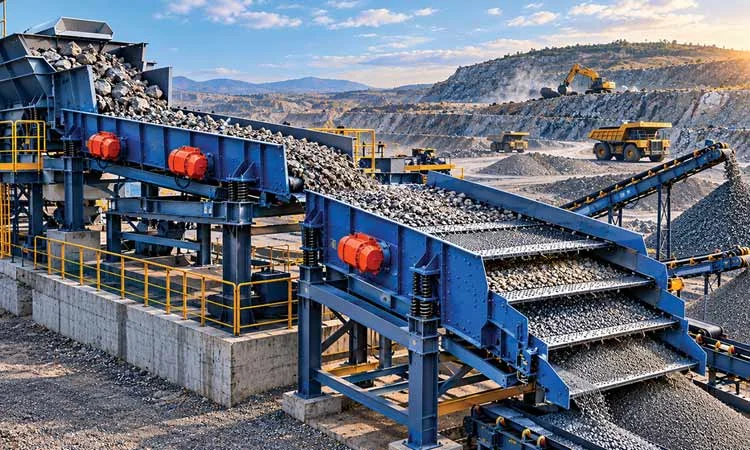
Mining and metal-processing operations depend on the continuous movement, sizing and classification of enormous quantities of bulk material. From run-of-mine ore and coal to crushed aggregates, iron ore, limestone, pellets and metal-bearing minerals, the efficiency of the entire processing chain depends heavily on how effectively material is fed, conveyed and separated. In this demanding environment, vibratory feeders and screens have evolved from relatively simple mechanical machines into sophisticated, high-capacity and increasingly intelligent systems.
Vibratory feeders regulate and deliver material to crushers, screens, mills and conveyors, while vibrating screens separate material according to particle size. Together, they form an important link between material handling and mineral processing. Their performance directly influences plant throughput, product quality, energy consumption and equipment availability. Vibrating screens remain among the most widely used screening technologies in mining and mineral-processing plants, from ROM scalping to fine classification.
The Critical Role of Controlled Feeding
The first requirement of an efficient processing plant is a consistent feed. Variations in feed rate can overload crushers and screens, cause material accumulation and reduce overall plant efficiency.
Vibratory feeders provide controlled, continuous movement of bulk material from hoppers, bins and stockpiles to downstream equipment. Their oscillating motion enables material to move forward in a controlled manner while allowing operators to regulate feed rates according to process demand.
In mining applications, feeders must handle abrasive, heavy and sometimes oversized material. Robust construction, wear-resistant liners and carefully engineered drive mechanisms are therefore essential.
Modern feeders are increasingly designed around the specific characteristics of the material—including particle size, density, moisture, abrasiveness and required throughput—rather than being treated simply as standard conveying equipment.
Advanced Vibratory Feeder Technology
Electromagnetic, unbalanced-motor and exciter-driven feeders provide different combinations of capacity, controllability and robustness. Variable-speed drives allow feed rates to be adjusted according to downstream requirements.
This is particularly valuable in automated plants. If a crusher is operating at a lower load, feeder speed can be reduced; when additional capacity becomes available, the feed rate can be increased.
Such closed-loop control reduces surges and helps maintain a stable material flow.
Grizzly feeders add another dimension by combining feeding and preliminary screening. Oversized rocks can be retained or diverted while finer material passes through the openings, reducing the load on the primary crusher. This can improve crushing efficiency and protect downstream equipment.
Vibrating Screens: The Separation Workhorses
Once material has been crushed or processed, it often needs to be separated into different size fractions. Vibrating screens perform this task by creating controlled movement across a screening surface.
As material travels over the deck, smaller particles pass through the apertures while larger particles continue towards the discharge end. Multi-deck screens can generate several size fractions from a single feed stream.
In mining, screens are used for scalping, sizing, classification, dewatering and preparation of material for subsequent processing. They are also used extensively in metal-ore beneficiation.
The design of a screen depends on several factors: feed characteristics, required cut size, capacity, moisture, particle shape, deck inclination, vibration characteristics and desired separation efficiency.
High-Capacity Screening
Modern mines increasingly demand higher throughput from smaller footprints. This has encouraged the development of larger screens with improved dynamic stability and more sophisticated excitation systems.
High-capacity screens must withstand substantial dynamic loads while maintaining accurate and consistent motion. Structural analysis and dynamic modelling have consequently become important elements of screen design.
The objective is not simply to increase screen size. The machine must deliver optimum particle movement, adequate stratification and sufficient screening time while avoiding excessive structural stresses and energy consumption.
High-Frequency Screening
Fine and ultra-fine mineral processing presents a different challenge. Conventional screening becomes increasingly difficult as particle size decreases.
High-frequency screens address this by using high-frequency, low-amplitude vibration. Such systems are particularly relevant in mineral processing applications requiring fine classification. Recent research and industry developments are also exploring improved excitation structures and operating strategies for more efficient fine screening.
Multi-deck high-frequency screens can provide substantial screening area within a relatively compact installation, making them attractive where plant space is limited.
Screen Media: The Interface with the Material
The screening surface is one of the most critical components of the machine. Steel wire mesh, perforated plates, rubber and polyurethane screen media are selected according to the application.
The choice involves balancing open area, wear resistance, flexibility, aperture accuracy and service life.
For highly abrasive ores, wear-resistant screen media can significantly reduce maintenance requirements. Flexible media can also help minimise blinding, where particles become lodged in apertures and reduce the effective screening area.
This is particularly important when processing moist, sticky or clay-containing material. Research has shown that moisture-induced particle agglomeration and aperture blinding can significantly affect screening performance.
Optimising Vibration
The performance of a vibrating screen is strongly influenced by amplitude, frequency, inclination, feed rate and vibration direction.
Too little vibration can result in poor stratification and inadequate separation. Excessive vibration, on the other hand, can accelerate wear, increase stresses and reduce process efficiency.
Modern engineering therefore focuses on optimising the complete vibration profile rather than simply increasing vibration intensity.
Advanced simulation techniques, including Discrete Element Method (DEM) modelling, are increasingly being used to study particle movement and optimise screen parameters. Research has demonstrated that factors such as inclination, vibration characteristics and feed rate have significant effects on both screening efficiency and screen-media wear.
Energy Efficiency
Energy efficiency is becoming increasingly important as mining companies seek to reduce operating costs and carbon emissions.
The challenge is to achieve maximum material throughput without excessive power consumption. Efficient drive systems, optimised vibration, improved screen geometry and reduced structural mass can all contribute.
Innovative screening concepts have also emerged in which only the screening surface is vibrated rather than the entire heavy machine structure. Such approaches can reduce the excited mass and potentially lower energy requirements.
Similarly, accurately controlled feeders prevent unnecessary overfeeding and help downstream equipment operate closer to its optimum operating point.
Digital Monitoring and Predictive Maintenance
Perhaps the most significant change taking place is the digitalisation of vibratory equipment.
Sensors can monitor vibration, temperature, bearing condition, motor performance and other operating parameters. Data can be analysed continuously to identify abnormal operating conditions.
Predictive maintenance can detect developing problems such as bearing deterioration, imbalance, misalignment or structural abnormalities before they result in unplanned shutdowns.
This is particularly valuable in mining, where equipment availability has a direct impact on production and where maintenance interventions can be expensive and logistically difficult.
Remote monitoring also enables operators and equipment suppliers to track machine performance without requiring continuous physical inspection.
Smarter and More Flexible Screening
Another emerging direction is adaptability. Mineral characteristics and production requirements can change during the life of a mine. A fixed machine configuration may therefore not always provide optimum performance.
Research into reconfigurable vibrating screens demonstrates the potential of modular screen configurations that can be adapted to changing production requirements.
Variable operating parameters and modular screen decks could make future systems more flexible, enabling operators to optimise equipment for different materials and production targets.
Applications in the Metal Industry
The importance of vibratory equipment extends well beyond mining. Steel plants, foundries, aluminium producers, ferroalloy plants and non-ferrous metal processors use feeders and screens for handling raw materials, scrap, pellets, coke, slag and processed products.
In steelmaking, for example, controlled feeding and screening can influence the consistency of raw materials entering subsequent processes. In foundries, vibratory systems are used for material handling, separation and reclamation applications.
The harsh environment of metal production places particular demands on equipment. High temperatures, abrasive materials, dust and heavy loads require robust construction and specialised wear protection.
The Road Ahead
The next generation of vibratory feeders and screens will increasingly combine mechanical robustness with digital intelligence.
Artificial intelligence and advanced analytics could eventually enable systems to adjust operating parameters automatically according to feed characteristics and real-time process performance. Digital twins and simulation tools can further improve equipment design and help optimise operating conditions before physical implementation.
The ultimate objective is clear: higher throughput, better separation, lower energy consumption, longer component life and reduced unplanned downtime.
Conclusion
Vibratory feeders and screens may appear to be straightforward pieces of bulk-material handling equipment, but their influence on mining and metal-processing productivity is profound. Every tonne of material must be moved and classified efficiently, reliably and economically.
Innovations in excitation systems, screen media, high-frequency operation, digital monitoring, simulation, automation and energy-efficient design are redefining their capabilities.
As mines and metal plants move towards higher productivity, greater automation and lower environmental impact, the humble feeder and screen are becoming increasingly sophisticated process-enabling technologies. Their evolution will play an important role in creating the smarter, more efficient and more sustainable mineral-processing plants of the future.