

What’s New in Data Acquisition Systems? Smarter, Faster, and More Connected than Ever
Your Sensor Data Used to Sit in a File. Now It Runs Your Factory.

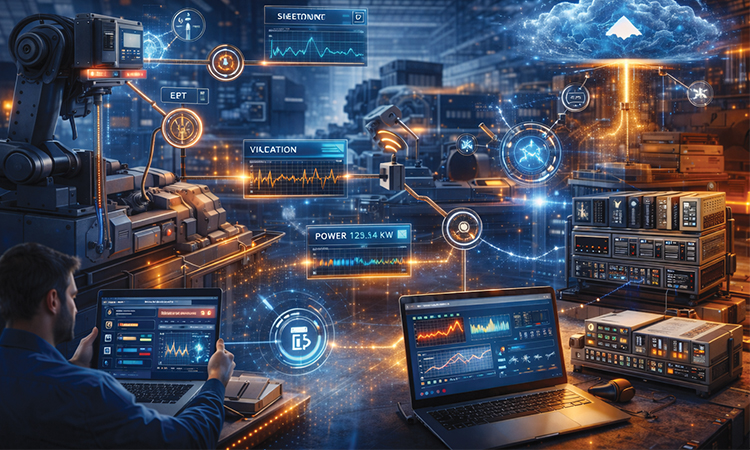
In today’s industrial environment, where efficiency, precision, and uptime are paramount, data acquisition systems (DAQ) have become indispensable tools. These systems serve as the bridge between the physical world and digital analytics, enabling industries to measure, monitor, and analyze parameters such as temperature, pressure, vibration, voltage, current, and flow in real time. Over the years, DAQ technology has evolved significantly, and the latest developments are making these systems more intelligent, flexible, and interconnected than ever before.
From Industry 4.0-driven manufacturing floors to advanced research laboratories and energy facilities, modern data acquisition systems are playing a critical role in enabling predictive maintenance, improving process control, and enhancing product quality. Let us explore some of the key innovations and trends that are redefining data acquisition systems today.
Integration with Industrial IoT
One of the most significant developments in data acquisition technology is its seamless integration with the Industrial Internet of Things (IIoT). Traditional DAQ systems were often standalone units used primarily for recording and storing data locally. Today’s systems are designed to connect effortlessly with IIoT platforms, enabling real-time monitoring and remote access.
With IIoT-enabled DAQ systems, data collected from sensors and machines can be transmitted to cloud platforms where it can be analyzed, visualized, and shared across multiple locations. This connectivity allows engineers and managers to monitor equipment performance, identify anomalies, and make informed decisions without being physically present at the site. Such capabilities are especially valuable in industries such as oil and gas, power generation, manufacturing, and infrastructure.
Edge Computing for Faster Insights
Another major advancement in modern data acquisition systems is the incorporation of edge computing. Instead of transmitting all raw data to a central server or cloud platform, edge-enabled DAQ devices process data locally at the source. This local processing reduces latency, minimizes network bandwidth usage, and allows faster decision-making. For example, in a high-speed production line, edge-based DAQ systems can instantly detect deviations in vibration or temperature and trigger alerts or corrective actions in real time. Edge computing also enhances system reliability, as operations can continue even when network connectivity is temporarily lost. This makes edge-enabled DAQ systems particularly useful in remote installations such as wind farms, mining operations, and offshore platforms.
Higher Sampling Rates and Precision
Modern industrial processes demand extremely accurate measurements and high-speed data capture. Recent advancements in DAQ hardware have led to significantly higher sampling rates and improved resolution. High-performance analog-to-digital converters (ADCs) are enabling systems to capture signals with remarkable accuracy. This is particularly important in applications such as structural testing, aerospace engineering, automotive development, and high-frequency vibration monitoring. In addition to faster sampling rates, modern systems also feature improved noise reduction, better signal conditioning, and enhanced calibration capabilities. These improvements ensure that the data collected is reliable and suitable for detailed analysis.
Modular and Scalable Architectures
Flexibility is another defining characteristic of the new generation of data acquisition systems. Modular architectures are becoming increasingly popular, allowing users to configure systems according to their specific requirements. In a modular DAQ system, different input modules can be added or replaced depending on the type of signals being measured. For instance, modules can be used for thermocouples, strain gauges, accelerometers, voltage signals, or digital inputs. This flexibility enables organizations to scale their systems as their measurement needs evolve.
Such modular systems also simplify maintenance and upgrades. Instead of replacing an entire system, users can simply upgrade individual modules, making the investment more cost-effective in the long run.
Wireless Data Acquisition
Wireless data acquisition is another trend gaining momentum across industries. Traditional wired systems can be expensive and complex to install, particularly in large plants or hazardous environments. Wireless DAQ systems eliminate the need for extensive cabling by transmitting sensor data via secure wireless communication protocols. This not only reduces installation costs but also makes it easier to monitor equipment located in hard-to-reach or moving locations. Applications such as structural health monitoring, rotating machinery diagnostics, and environmental monitoring are benefiting significantly from wireless DAQ solutions. Battery-powered wireless sensors with long operational life are making continuous monitoring more practical and economical.
Cloud-Based Data Management
The adoption of cloud computing is also transforming how data acquisition systems are used. Cloud-based platforms provide virtually unlimited storage and powerful analytics capabilities.
Data collected by DAQ systems can be uploaded to the cloud where it can be analyzed using advanced algorithms, machine learning models, and predictive analytics tools. Engineers can visualize trends, generate reports, and set automated alerts when parameters exceed predefined limits. Cloud integration also facilitates collaboration across teams and locations. For multinational organizations, this means that data from plants across the globe can be accessed and analyzed from a single dashboard.
Enhanced Software and User Interfaces
Modern data acquisition systems are no longer just hardware devices; they are supported by sophisticated software platforms that make data analysis easier and more intuitive.
Advanced DAQ software now offers features such as real-time dashboards, automated reporting, graphical data visualization, and customizable alerts. Many systems also support integration with popular data analysis environments and industrial control platforms. User interfaces have become more user-friendly, allowing engineers to configure measurement channels, calibrate sensors, and analyze data without requiring extensive programming expertise. This ease of use is encouraging wider adoption of DAQ technology across different industrial sectors.
 Improved Cybersecurity
As DAQ systems become increasingly connected to networks and cloud platforms, cybersecurity has become a major concern. Modern systems are therefore being designed with enhanced security features to protect sensitive operational data. Encryption protocols, secure authentication mechanisms, and role-based access control are now commonly incorporated into DAQ platforms. These measures help prevent unauthorized access and safeguard industrial infrastructure from cyber threats. In industries such as energy, defense, and critical manufacturing, where data integrity is crucial, robust cybersecurity features are becoming a key requirement when selecting data acquisition systems.
Role in Predictive Maintenance
Perhaps one of the most impactful applications of modern data acquisition systems is in predictive maintenance. By continuously monitoring parameters such as vibration, temperature, and load conditions, DAQ systems help detect early signs of equipment deterioration. Advanced analytics tools can analyze this data to predict potential failures before they occur. This allows maintenance teams to schedule repairs proactively, reducing unexpected downtime and extending equipment life. Predictive maintenance supported by DAQ technology is now widely adopted in sectors such as manufacturing, transportation, power generation, and heavy engineering.
The Road Ahead
The future of data acquisition systems looks promising as emerging technologies continue to enhance their capabilities. Artificial intelligence, machine learning, and digital twin technologies are expected to play a greater role in analyzing and interpreting the vast amounts of data generated by modern industrial systems. As industries move further toward smart manufacturing and autonomous operations, data acquisition systems will remain a cornerstone of digital transformation. By providing accurate, real-time insights into processes and equipment performance, these systems will continue to help organizations improve efficiency, reduce costs, and maintain high levels of reliability. In essence, today’s data acquisition systems are no longer just measurement tools—they are intelligent platforms that enable data-driven decision-making across the entire industrial ecosystem.