

Metrology & Quality Assurance in Die & Mould Manufacture : Ensuring Precision at Every Micron
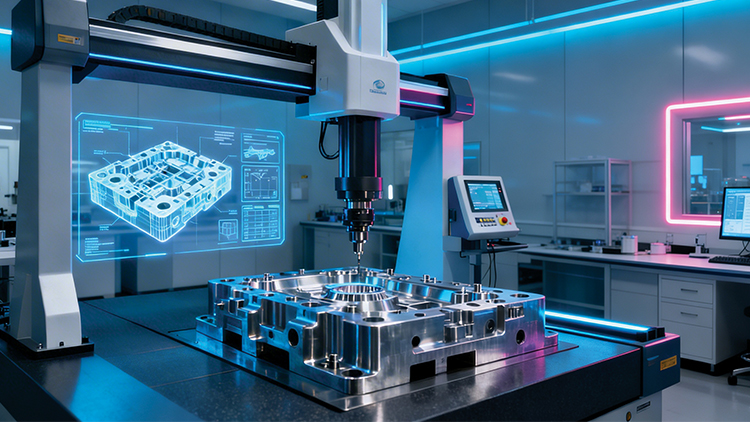
In the highly competitive and precision-driven world of die and mould manufacturing, metrology and quality assurance (QA) form the backbone of operational excellence. Dies and moulds are critical tools used across industries such as automotive, aerospace, consumer goods, and electronics. Any deviation, even at the micron level, can lead to defective products, increased scrap rates, and costly rework. Hence, integrating advanced metrology techniques with robust quality assurance systems is not just desirable—it is indispensable.
The Critical Role of Metrology
Metrology, the science of measurement, is fundamental to die and mould manufacturing. It ensures that every component produced adheres to stringent dimensional and geometric tolerances. From the initial design stage to final inspection, metrology plays a continuous and evolving role. Modern die and mould manufacturing demands high precision, often within tolerances of ±5 microns or less. This level of accuracy requires sophisticated measurement tools and techniques. Coordinate Measuring Machines (CMMs), optical measurement systems, laser scanners, and vision-based inspection systems are widely used to verify dimensions, form, and surface characteristics. CMMs, in particular, are the workhorses of metrology labs.
They enable precise 3D measurement of complex geometries and freeform surfaces typical of mould cavities. With the integration of CAD models, CMMs allow for direct comparison between the designed and manufactured components, highlighting deviations in real time. Optical and non-contact measurement systems are gaining prominence, especially for delicate or highly intricate parts. These systems offer faster data acquisition and eliminate the risk of probe-induced errors, making them ideal for high-speed inspection environments.
Quality Assurance: Beyond Inspection
While metrology focuses on measurement, quality assurance encompasses the entire framework that ensures consistent product quality. QA is not limited to final inspection; it is embedded throughout the manufacturing lifecycle. A robust QA system begins at the design stage. Design for Manufacturability (DFM) and Design for Inspection (DFI) principles are incorporated to ensure that components can be produced and measured effectively. Simulation tools are used to predict potential issues such as shrinkage, warpage, and stress concentration, enabling proactive design corrections. During manufacturing, in-process quality checks are essential.
Machine tool calibration, tool wear monitoring, and process capability analysis (Cp and Cpk) help maintain consistency. Statistical Process Control (SPC) is widely used to monitor critical parameters and detect variations before they lead to defects. Post-production, rigorous inspection protocols validate the final product. This includes dimensional checks, surface finish evaluation, hardness testing, and functional testing where applicable. Documentation and traceability are integral, ensuring that every component can be tracked back to its production parameters.
Advanced Technologies Transforming QA and Metrology
The advent of Industry 4.0 has revolutionized metrology and quality assurance in die and mould manufacturing. Digitalization, automation, and data analytics are enabling smarter and more efficient quality control processes.
1. Digital Metrology and CAD Integration:
Modern metrology systems are seamlessly integrated with CAD/CAM software. This allows for real-time comparison between the scanned data and the digital model, enabling faster decision-making and reducing inspection time.
2. 3D Scanning and Reverse Engineering:
3D scanning technologies are widely used for capturing complex geometries and generating digital twins of physical components. This is particularly useful for reverse engineering, repair, and modification of existing dies and moulds.
3. In-Machine Measurement:
On-machine probing systems enable measurement directly on the CNC machine. This reduces the need for part removal and re-fixturing, minimizing errors and improving productivity. It also allows for real-time correction of machining parameters.
4. Automation and Robotics:
Automated inspection systems, often integrated with robotic arms, are increasingly used for high-volume production. These systems enhance repeatability, reduce human error, and improve throughput.
5. Data Analytics and AI:
Advanced analytics tools are used to analyze measurement data and identify patterns. Artificial Intelligence (AI) can predict potential defects and recommend corrective actions, leading to predictive quality assurance.
Surface Integrity and Its Importance
In die and mould manufacturing, surface quality is as critical as dimensional accuracy. Surface roughness, waviness, and micro-cracks can significantly impact the performance and lifespan of the tool. Surface metrology tools such as profilometers and interferometers are used to assess surface characteristics. Achieving the desired surface finish often involves multiple stages of polishing and finishing, each requiring careful monitoring. Poor surface quality can lead to issues such as poor material flow, increased wear, and reduced product quality. Therefore, maintaining surface integrity is a key aspect of quality assurance.
Calibration and Traceability
Calibration is a cornerstone of reliable metrology. All measurement instruments must be regularly calibrated against national or international standards to ensure accuracy and consistency. Traceability ensures that every measurement can be linked back to a recognized standard. This is particularly important in industries with stringent regulatory requirements, such as aerospace and medical devices. A well-maintained calibration schedule, along with proper documentation, enhances confidence in measurement results and supports compliance with quality standards such as ISO 9001 and ISO/TS 16949.
Challenges in Metrology and QA
Despite technological advancements, several challenges persist in die and mould metrology and quality assurance:
• Complex Geometries: Measuring intricate shapes and freeform surfaces remains a challenge, requiring advanced equipment and skilled operators.
• Time Constraints: High production demands often limit the time available for thorough inspection.
• Skill Gap: Operating sophisticated metrology equipment requires specialized training, which may not always be readily available.
• Cost Considerations: High-end metrology equipment involves significant investment, which can be a barrier for small and medium enterprises.
Addressing these challenges requires a balanced approach that combines technology, training, and process optimization.
The Road Ahead
The future of metrology and quality assurance in die and mould manufacturing is poised for further transformation. Emerging technologies such as augmented reality (AR) for inspection, cloud-based quality management systems, and real-time digital twins will redefine how quality is monitored and controlled. Sustainability is also becoming a key focus. Efficient quality assurance processes reduce material waste, energy consumption, and rework, contributing to greener manufacturing practices. Moreover, the increasing demand for customization and shorter product lifecycles will necessitate faster and more flexible QA systems. Agile quality assurance frameworks, supported by digital tools, will be critical in meeting these demands.
Conclusion
Metrology and quality assurance are not just supporting functions in die and mould manufacturing—they are strategic enablers of precision, reliability, and competitiveness. By leveraging advanced measurement technologies, integrating quality into every stage of production, and embracing digital transformation, manufacturers can achieve unparalleled levels of accuracy and efficiency. In an industry where every micron matters, a robust metrology and QA framework is the key to delivering excellence consistently.