


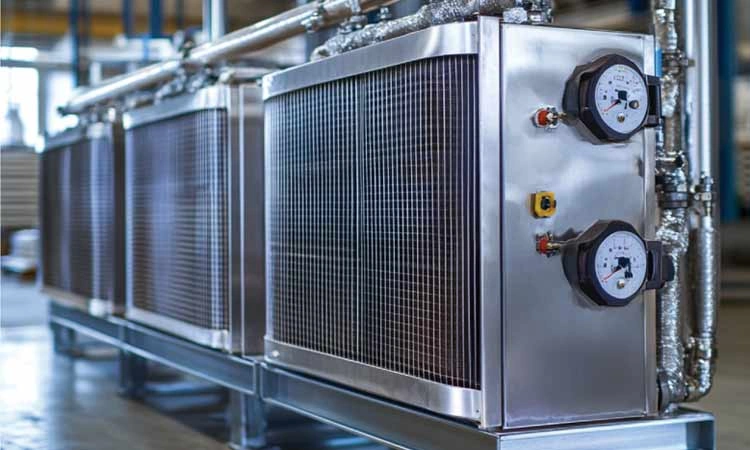
Plate heat exchangers (PHEs) have become an important component of modern thermal-management systems, offering compactness, high heat-transfer efficiency and operational flexibility. They are widely used in process industries, food and beverage, pharmaceuticals, chemicals, power generation, HVAC, refrigeration, district cooling and industrial machinery. As industries seek to reduce energy consumption, water usage and operating costs, the design of plate heat exchangers is increasingly focused on achieving maximum thermal performance with minimum pressure drop, footprint and lifecycle cost.
Optimising Plate Geometry
The geometry of the heat-transfer plate is fundamental to PHE performance. Corrugations create turbulence in the fluid flow, improving heat transfer while maintaining a relatively compact equipment footprint. Different chevron angles, corrugation depths and patterns can be selected according to the application.
Higher corrugation angles generally promote stronger turbulence and higher heat-transfer coefficients, but they can also increase pressure drop. Consequently, plate design involves finding the right balance between heat-transfer performance and pumping energy.
Modern computational tools, including Computational Fluid Dynamics (CFD), are increasingly used to study flow patterns and optimise plate geometry before manufacturing.
Correct Thermal and Hydraulic Sizing
An efficient heat exchanger must be correctly sized for both its thermal duty and hydraulic conditions. Designers must consider inlet and outlet temperatures, flow rates, fluid properties, allowable pressure drop, fouling tendency and operating conditions.
Oversizing can increase equipment cost and footprint without providing proportional benefits, while undersizing may result in inadequate heat transfer and excessive pressure drop. Accurate thermal modelling is therefore essential for selecting the appropriate number of plates and effective heat-transfer area.
The design should also accommodate variations in operating conditions rather than being optimised only for one nominal load.
Selection of Plate Materials
Material selection has a direct influence on heat-transfer performance, corrosion resistance, durability and lifecycle cost. Stainless steel is widely used for general industrial applications, while specialised alloys may be required for aggressive or corrosive fluids.
Titanium, nickel alloys and other high-performance materials can be considered for applications involving seawater, chlorides or chemically aggressive media.
The choice should reflect not only the thermal conductivity of the material but also corrosion behaviour, mechanical strength, temperature capability and compatibility with the process fluid.
Gasket Design and Reliability
In gasketed plate heat exchangers, the gasket is critical to sealing performance. Gasket material must be compatible with the process fluid and operating temperature.
Elastomers such as EPDM, NBR and FKM are selected according to application requirements. Correct gasket compression and plate alignment are essential for preventing leakage.
Modern gasket designs aim to improve sealing reliability while simplifying maintenance and replacement. For demanding applications, designers may also consider brazed or welded plate heat exchangers, which eliminate conventional gasket-related limitations.
Minimising Pressure Drop
Pressure drop is an important design consideration because excessive resistance increases pumping or compressor energy consumption. A heat exchanger designed solely for maximum heat-transfer coefficient may therefore become inefficient at the system level.
Effective design seeks to achieve the required heat duty within an acceptable pressure-drop envelope. Channel arrangement, plate pattern, port dimensions and flow velocity must be carefully considered.
The objective is maximum useful heat transfer per unit of pumping energy, rather than simply achieving the highest possible heat-transfer coefficient.
Counter-Current Flow Arrangement
Counter-current flow is generally preferred where practical because it provides a stronger temperature-driving force across much of the heat exchanger. This enables high heat recovery and can allow the required thermal duty to be achieved with a smaller heat-transfer area.
Proper pass arrangement is particularly important when fluids have significantly different flow rates or temperature characteristics. Multi-pass configurations can also improve performance where application-specific requirements demand them.
Fouling Management
Fouling can significantly reduce heat-transfer performance and increase pressure drop. Deposits may develop because of suspended solids, scale formation, biological growth, chemical reactions or degradation of process fluids.
Designers therefore need to consider fluid cleanliness and fouling characteristics from the beginning. Appropriate channel velocity can help reduce deposition, while filtration and water treatment can further improve performance.
One of the major advantages of gasketed PHEs is their ability to be opened and mechanically cleaned. This accessibility can significantly reduce maintenance time compared with some conventional heat-exchanger designs.
Flow Distribution
Uniform distribution of fluid across the plate pack is essential for achieving the expected thermal performance. Poor distribution can create stagnant zones, excessive local velocities or uneven heat transfer.
Port geometry and distribution areas should therefore be carefully designed to minimise maldistribution. CFD analysis can provide valuable insight into how fluids enter, spread through and exit the plate channels.
Improved distribution not only enhances heat transfer but can also reduce localised fouling and erosion.
Energy-Efficient Heat Recovery
PHEs are particularly effective for heat recovery because of their high heat-transfer coefficients and compact configuration. Waste heat from industrial processes can be transferred to incoming process fluids, boiler feedwater, cleaning systems or building-heating circuits.
In many installations, recovering otherwise wasted thermal energy can reduce fuel consumption and associated emissions. Designers should therefore evaluate opportunities for heat integration, rather than treating the heat exchanger as an isolated component.
Compactness and Footprint
One of the most attractive characteristics of plate heat exchangers is their high heat-transfer area relative to volume. This makes them significantly more compact than many traditional shell-and-tube arrangements for comparable duties.
Compactness reduces installation space and can simplify plant layout. Modular plate construction also allows additional plates to be added in many gasketed designs if future capacity requirements increase.
This flexibility is particularly valuable in plants where production capacity is expected to expand.
Digital Monitoring and Predictive Maintenance
Modern PHE installations are increasingly being integrated into digital plant-management systems. Sensors can monitor inlet and outlet temperatures, flow rates and pressure differential.
Changes in pressure drop or temperature performance can provide early indications of fouling, scaling, leakage or flow problems. Data analytics can then support condition-based and predictive maintenance, allowing operators to clean or service the heat exchanger before performance deteriorates significantly.
Such monitoring helps maintain efficiency throughout the equipment’s operating life.
Conclusion
The design of an efficient plate heat exchanger involves far more than maximising heat-transfer area. Plate geometry, thermal sizing, pressure drop, material selection, flow distribution, gasket reliability, fouling control and maintainability must all be considered together.
The next generation of PHEs will increasingly combine advanced plate designs, simulation-driven optimisation, improved materials and digital monitoring. By focusing on total lifecycle performance rather than initial equipment cost, industries can achieve higher thermal efficiency, lower pumping energy, reduced maintenance requirements and improved sustainability.
In an era where every unit of energy matters, well-designed plate heat exchangers offer a powerful pathway to recover more heat, consume less energy and make industrial processes more efficient.