

Reer and Cefla : When Safety Becomes Part of The Process
Safety Stopped the Line. Then ReeR Rebuilt It So It Never Has To.
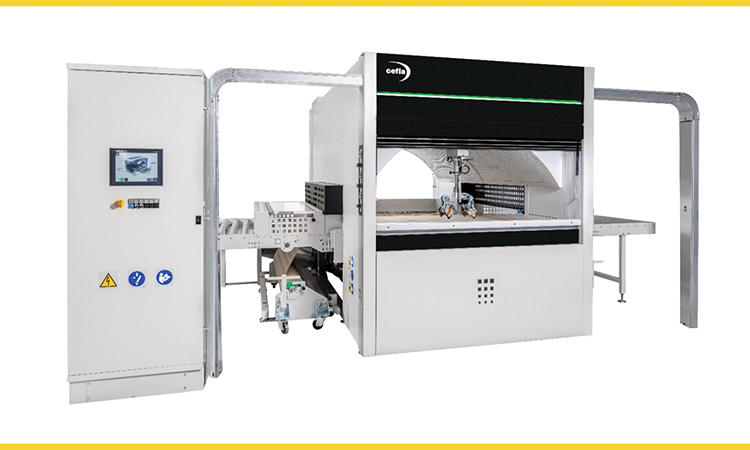
In the world of finishing lines, safety and productivity are often seen as two forces in a delicate balance. Protecting the operator without slowing down the production cycle is a real challenge, especially in highly automated environments. It is precisely here that the value of the collaboration between ReeR Safety and Cefla Finishing lies.
A global partner with complex requirements
Cefla Finishing is now one of the world’s leading players in the design of machines and integrated lines for painting, decoration and digital printing. Its solutions operate in sectors where quality, repeatability and production continuity are non-negotiable. In this context, every component of the line must contribute to a common goal: ensuring high performance without compromising safety.
The customer’s need: combining process control and safety
In Cefla’s production lines, a clear yet challenging requirement becomes apparent from the outset: to effectively manage both process data acquisition and all safety functions, whilst avoiding separate systems and non-integrated logic. On the one hand, it is essential to know the characteristics of the workpiece in real time, in order to optimise critical stages such as paint application. On the other hand, it is vital to ensure the protection of operators in an environment characterised by multiple risk areas: automated conveyors, paint booths, processing stations and loading and unloading zones. These requirements also fall within a strict regulatory framework, which imposes stringent requirements in terms of functional safety and the design of protective measures.
• Machinery Directive 2006/42/CE
• EN ISO 13849-1
• EN ISO 13855
And this is precisely where the most interesting challenge lies: ensuring that safety and process control do not run on parallel tracks.
An integrated architecture: the role of ReeR Safety technologies
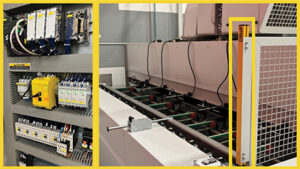
The solution developed in collaboration with ReeR is based on an architecture in which each technology has a specific role, yet contributes to a single, coherent system. The MICRON series measurement barriers are used to acquire process data. By reading the photodiodes, they enable the profile of the panels along the line to be detected in real time. The information collected is processed by the PLC to reconstruct the part’s geometry and dynamically optimise paint application. It is worth considering one point here: this type of measurement involves no physical contact or slowdowns. This means that quality control takes place in-line, without compromising production continuity. It is not a minor detail; it is a design choice.
For this specific application, the ReeR MICRON MI 1351 B measurement light curtain with digital outputs was selected
• Controlled height 1340 mm
• Beam spacing 10 mm
• Max range 10 m
At the same time, EOS safety light curtains monitor access to hazardous areas, detecting the presence of the operator and triggering a safe machine stop in the event of intrusion. Protection is therefore active and immediate, but designed to intervene only when necessary, avoiding unnecessary interruptions to the process.
In this specific application, the ReeR EOS2 603 X safety light curtain was used
• Safety Level Tipo 2 – PL c
• Resolution 30 mm
• Controlled height 610 mm
• Max range 12 m
• Built-in – User selectable automatic or manual
The MOSAIC M1S COM controller coordinates these two levels: process and safety.
The key role of centralised control
The MOSAIC controller acts as the central hub of the entire system. It does not merely “manage safety” but establishes a centralised control logic in which all devices communicate seamlessly. Safety light curtains, sensors and emergency stop devices are monitored and managed within a single architecture. This allows for the implementation of reliable yet flexible stop and restart logic, adapting to the various configurations of Cefla machines. Thanks to Ethernet communication, the status of the devices is always available to the supervisory system. This introduces an often underestimated advantage: the ability to perform real-time diagnostics, reducing downtime and increasing the responsiveness of interventions.
Safety that doesn’t slow things down, but enables
At this point, it is worth challenging a widespread misconception: that greater safety equates to lower productivity. On Cefla production lines, the exact opposite is true. The integration of EOS safety barriers, MICRON measurement systems and the MOSAIC controller makes it possible to protect high-risk areas without interrupting the production flow, whilst at the same time improving process control. Emergency stop devices are also part of this integrated approach: every activation is managed by the controller in a coordinated manner, ensuring the safe stopping of all moving parts, including the most critical ones, whilst the information remains available for diagnostics. The result is not just a safer machine, but a more “aware” machine. When viewing the system as a whole, a key element emerges: the integration of safety and process. The devices are no longer separate elements, but parts of a single architecture that protects, measures and optimises. This approach is perfectly in line with the principles of safe design according to EN ISO 12100, where safety is integrated from the earliest stages of development.
Tangible benefits, beyond compliance
The results achieved by Cefla through the adoption of ReeR safety solutions go far beyond mere compliance with regulations. Operator safety is guaranteed, yet the line maintains high levels of operational continuity. More precise process control reduces errors and waste, whilst the modular architecture makes the system flexible and scalable over time. At this point, the question is no longer whether safety is a constraint to be managed, but whether it can become an enabling factor. In the case of Cefla’s lines, the answer is already part of the process.