

Gear Motors Types & Applications
1 Motor + 1 Gearbox = The Workhorse Behind Every Industrial Machine

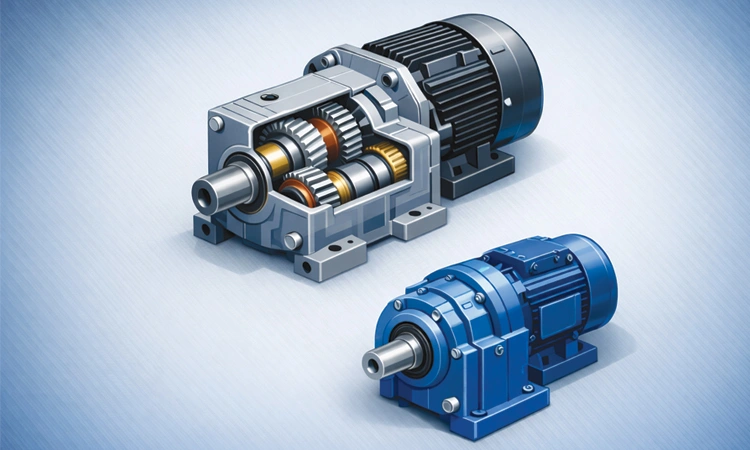
In modern industry, the demand for controlled motion, reliable torque transmission, and energy-efficient drive systems has never been greater. At the heart of countless machines—from simple conveyors to complex automated production lines—lies a compact yet powerful solution: the gear motor. By integrating an electric motor with a gearbox into a single, unified unit, gear motors provide a practical and efficient means of converting electrical energy into controlled mechanical motion. Their versatility, robustness, and cost-effectiveness have made them indispensable across manufacturing, infrastructure, and process industries.
What Is a Gear Motor?
A gear motor is a self-contained drive unit that combines an electric motor with a speed-reducing gearbox. While electric motors typically operate at high speeds with relatively low torque, most industrial applications require lower speeds and higher torque. The gearbox bridges this gap by reducing speed and proportionally increasing torque at the output shaft.
Unlike separate motor-and-gearbox assemblies, gear motors offer advantages in terms of compactness, alignment accuracy, ease of installation, and reliability. They are available in a wide range of power ratings, reduction ratios, mounting configurations, and protection classes, making them suitable for diverse operating environments.
Why Gear Motors Are Widely Used
One of the primary reasons for the widespread adoption of gear motors is their ability to deliver consistent torque at controlled speeds. By selecting the appropriate gear ratio, designers can precisely match motor output to application requirements. Gear motors also contribute to improved system efficiency, reduced mechanical complexity, and lower maintenance costs.
From an operational standpoint, gear motors enhance safety and longevity by reducing mechanical stress on components. The integrated design minimizes coupling errors, vibration, and noise, while also simplifying spare parts management and installation.
Types of Gear Motors
Gear motors are broadly classified based on the type of gearing used in the gearbox. Each type offers distinct performance characteristics and is suited to specific applications.
Helical Gear Motors are among the most commonly used types. Their angled gear teeth provide smooth and quiet operation with high efficiency. Helical gear motors are ideal for continuous-duty applications requiring moderate to high torque, such as conveyors, material handling systems, and mixers.
Spur Gear Motors use straight-cut gears and are typically more economical. While they are slightly noisier than helical gears, they offer high efficiency and are suitable for low- to medium-load applications where cost is a key consideration.
Bevel Gear Motors transmit power between shafts at right angles. Compact and efficient, they are widely used in applications where space constraints demand a change in drive direction, such as packaging machinery, textile equipment, and lifting systems.
Worm Gear Motors are known for their high reduction ratios in a compact size. They provide smooth, shock-absorbing operation and inherent self-locking characteristics in many configurations, making them suitable for hoists, elevators, gates, and positioning systems. However, their efficiency is generally lower compared to other gear types.
Planetary Gear Motors combine high torque density with compact design and excellent efficiency. With load shared across multiple planet gears, they are ideal for applications demanding high precision, high torque, and compact dimensions, such as robotics, machine tools, and servo-driven systems.
Motor Types Used in Gear Motors
Gear motors can be paired with different motor technologies depending on application requirements. AC induction motors are the most common, valued for their robustness, simplicity, and cost-effectiveness. They are widely used in conveyors, pumps, and fans.
DC motors, including brushed and brushless variants, offer precise speed control and high starting torque, making them suitable for battery-powered or variable-speed applications. Servo motors and stepper motors are used in precision gear motor assemblies where accurate positioning and dynamic response are critical, such as CNC machines and automation equipment.
Applications Across Industries
The versatility of gear motors has led to their extensive use across virtually every industrial sector. In material handling, gear motors drive conveyors, bucket elevators, and automated storage systems, ensuring smooth and controlled movement of goods. In manufacturing and assembly lines, they power indexing tables, feeders, and transfer systems that require synchronized motion.
In the process industries, gear motors are used in mixers, agitators, and dosing systems, where reliable torque and continuous operation are essential. Packaging and food processing machinery relies on gear motors for precise timing, speed control, and hygiene-friendly designs. Infrastructure and utility sectors also benefit from gear motors in applications such as water treatment plants, escalators, gates, and HVAC systems. In recent years, the rise of automation and smart factories has further expanded the role of gear motors in robotics, automated guided vehicles (AGVs), and warehouse automation.
Design and Selection Considerations
Selecting the right gear motor requires a thorough understanding of application demands. Key parameters include required output torque, operating speed, duty cycle, ambient conditions, and mounting orientation. Overlooking factors such as shock loads, thermal performance, or environmental protection can lead to premature failure or inefficiency. Efficiency and energy consumption are increasingly important considerations, especially in continuous-duty applications. Gear motors with high-efficiency motors and optimized gear designs contribute significantly to energy savings and compliance with modern efficiency standards.
Noise, vibration, and maintenance requirements also influence selection, particularly in applications where operator comfort or clean operation is essential.
Emerging Trends in Gear Motor Technology
Advances in materials, manufacturing processes, and digitalization are reshaping gear motor design. High-efficiency motors compliant with global energy standards, lightweight housings, and improved lubrication systems are enhancing performance and durability.
Integration with variable frequency drives (VFDs) and smart sensors enables real-time monitoring of speed, load, and temperature, supporting predictive maintenance and improved uptime. As Industry 4.0 concepts gain traction, gear motors are becoming smarter, more connected, and more adaptable.
Conclusion
Gear motors represent a cornerstone of modern industrial motion systems, offering a reliable, compact, and efficient solution for a wide range of applications. With multiple gear and motor types available, they can be tailored to meet specific operational requirements across industries. Understanding the different types of gear motors and their applications empowers engineers and decision-makers to select optimal drive solutions that enhance performance, efficiency, and reliability.
As automation and energy efficiency continue to shape the future of industry, gear motors will remain a vital component in enabling smarter, faster, and more sustainable machines.