

The Long and Short of Welding Electrode Manufacturing
Behind the Scenes of a Critical Consumable that Holds Industry Together

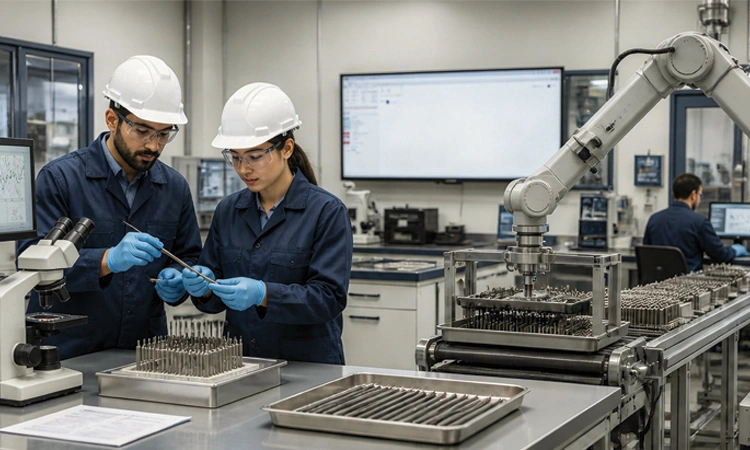
From towering skyscrapers and sprawling bridges to power plants, pipelines, shipyards, and heavy engineering facilities, welding remains one of the most indispensable manufacturing and fabrication processes. At the heart of many welding operations lies a seemingly simple consumable—the welding electrode. Though often overshadowed by sophisticated welding equipment and automation technologies, the electrode plays a decisive role in determining weld quality, strength, productivity, and reliability.
The manufacturing of welding electrodes is a highly specialized process that combines metallurgy, chemistry, precision engineering, and stringent quality control. Producing a welding electrode may appear straightforward, but behind every stick electrode lies a carefully controlled sequence of operations designed to ensure consistent performance under demanding industrial conditions.
Understanding the Welding Electrode
A welding electrode serves two primary functions. First, it conducts electrical current to create the welding arc. Second, it supplies filler metal that forms the weld joint.
In shielded metal arc welding (SMAW), commonly known as stick welding, the electrode consists of a metal core wire surrounded by a specially formulated flux coating. During welding, the core wire melts and becomes part of the weld deposit, while the flux coating generates protective gases and slag that shield the molten metal from atmospheric contamination.
The quality of both the core wire and the coating determines the electrode’s welding characteristics, mechanical properties, arc stability, and resistance to defects.
![welding electrode manufacturing]() The Importance of Raw Material Selection
The Importance of Raw Material Selection
 The Importance of Raw Material Selection
The manufacturing journey begins with the selection of raw materials.
The core wire is typically produced from carefully controlled steel grades whose chemical composition must conform to stringent standards. Variations in carbon, manganese, silicon, sulfur, phosphorus, and other alloying elements can significantly affect weld performance.
The coating materials are even more complex. Electrode manufacturers formulate coatings using a combination of minerals, ferroalloys, cellulose, rutile, limestone, fluorspar, silica, and various binders. Each ingredient performs a specific function, such as arc stabilization, slag formation, deoxidation, alloy addition, or shielding gas generation.
Consistency in raw material quality is critical because even minor variations can alter welding behavior and compromise weld integrity.
Core Wire Preparation
The manufacturing process begins with wire rod production and preparation.
Steel wire rods are drawn through a series of dies to achieve the required diameter and dimensional accuracy. During this process, surface defects, scale, and impurities are carefully removed to ensure a clean substrate for coating application.
The wire is then straightened and cut into precise lengths depending on the electrode type and intended application.
Stringent dimensional controls are maintained because uniformity directly influences coating thickness and welding performance.
Modern electrode plants employ automated wire preparation systems capable of producing thousands of perfectly sized electrode cores every hour.
The Science of Flux Coating Formulation
The flux coating is often considered the “brain” of the welding electrode.
Manufacturers invest considerable research and development efforts into creating formulations tailored to specific welding applications. Electrodes intended for structural steel fabrication require different coating characteristics than those used in pressure vessels, pipelines, stainless steel fabrication, or hard-facing applications.
The coating ingredients are carefully weighed and blended according to proprietary formulations developed through years of metallurgical research.
Achieving uniform mixing is essential. Advanced mixers ensure that each batch possesses identical chemical and physical characteristics, guaranteeing consistency from one production run to another.
In many cases, electrode formulations represent valuable intellectual property and a key source of competitive advantage.
Extrusion: The Heart of Electrode Manufacturing
Once the coating mixture is prepared, the manufacturing process moves to the extrusion stage.
The dry coating ingredients are combined with a binder solution to create a plastic mass suitable for extrusion. This material is then fed into specialized extrusion machines where it is uniformly applied around the core wire.
Extrusion is one of the most critical operations in electrode manufacturing. The coating must be perfectly concentric around the wire to ensure balanced melting characteristics and stable arc performance.
Any eccentricity can result in uneven burning, excessive spatter, arc instability, or poor weld quality.
Modern extrusion equipment incorporates sophisticated controls that maintain consistent coating thickness, density, and concentricity throughout production.
Drying and Baking: Ensuring Performance
Freshly extruded electrodes contain moisture that must be carefully removed before packaging.
Drying and baking operations are therefore essential stages in electrode manufacture. Electrodes pass through controlled-temperature ovens where moisture is gradually eliminated without damaging the coating structure.
The baking process enhances coating strength, improves handling characteristics, and reduces hydrogen content.
For low-hydrogen electrodes used in critical applications such as pressure vessels, offshore structures, and power plants, moisture control is particularly important. Excessive hydrogen can cause weld cracking and compromise structural integrity.
Manufacturers therefore maintain strict temperature profiles and environmental controls during drying and baking operations.
![welding electrode manufacturing]() Quality Control at Every Stage
Quality Control at Every Stage
 Quality Control at Every Stage
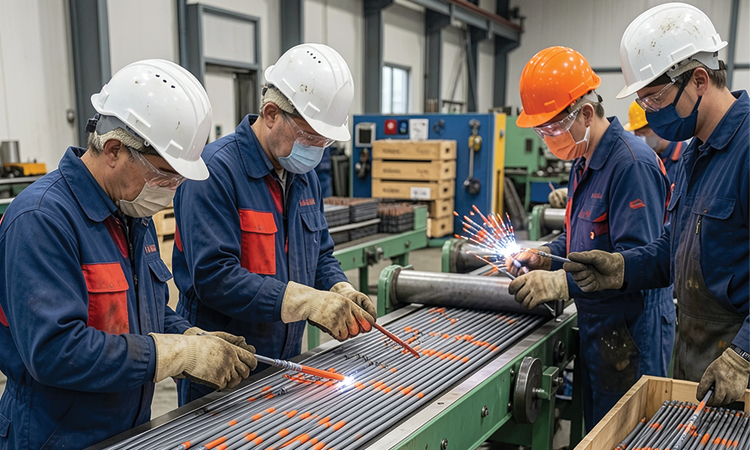
The manufacture of welding electrodes demands rigorous quality assurance procedures.
Testing begins with incoming raw materials and continues throughout every production stage. Samples are routinely examined for dimensional accuracy, coating integrity, moisture content, chemical composition, and mechanical properties.
Finished electrodes undergo extensive performance testing, including:
- Arc stability evaluation
- Weld bead appearance assessment
- Slag detachability testing
- Spatter measurement
- Tensile strength verification
- Impact toughness testing
- Bend testing
- Radiographic examination
Many manufacturers maintain dedicated welding laboratories where electrodes are tested under simulated field conditions.
Compliance with international standards such as AWS, ISO, BIS, and EN specifications is essential for acceptance in critical industrial applications.
Automation Reshaping Electrode Production
Like many manufacturing sectors, welding electrode production is increasingly benefiting from automation and digital technologies.
Modern production lines incorporate automated weighing systems, computerized batching, robotic handling, and real-time process monitoring.
Advanced sensors continuously track key parameters such as coating thickness, wire alignment, extrusion pressure, and oven temperatures. Data analytics help identify process variations before they affect product quality.
Automation not only improves consistency but also increases productivity and reduces manufacturing costs.
As demand for high-performance welding consumables grows, digital manufacturing practices are becoming essential competitive differentiators.
![welding electrode manufacturing
(Electrode-Manufacturing)]() Specialized Electrodes for Emerging Industries
Specialized Electrodes for Emerging Industries
 Specialized Electrodes for Emerging Industries
Industrial requirements continue to evolve, creating demand for increasingly specialized welding electrodes.
Modern manufacturers now produce electrodes tailored for sectors such as renewable energy, nuclear power, aerospace, offshore engineering, and advanced infrastructure projects.
Special-purpose electrodes offer enhanced corrosion resistance, superior impact toughness, improved fatigue performance, and compatibility with exotic materials.
Research continues into consumables capable of supporting new-generation steels, high-temperature alloys, and advanced manufacturing processes.
These developments are expanding the role of welding electrodes beyond traditional fabrication applications.
Sustainability in Electrode Manufacturing
Environmental responsibility is becoming an important consideration for electrode manufacturers.
Efforts are underway to reduce energy consumption during production, minimize waste generation, and improve resource utilization. Energy-efficient ovens, dust collection systems, and recycling initiatives are helping manufacturers reduce their environmental footprint.
Some producers are also exploring environmentally friendly coating formulations and cleaner production technologies that align with global sustainability goals.
As industries increasingly focus on carbon reduction, welding consumable manufacturers are expected to play an active role in supporting greener manufacturing practices.
The Road Ahead
Despite the growing adoption of advanced welding processes such as MIG, TIG, laser, and robotic welding, stick electrodes continue to occupy a vital position in global fabrication and maintenance activities. Their versatility, portability, and ability to perform reliably in challenging environments ensure their continued relevance.
The future of welding electrode manufacture will be shaped by advances in metallurgy, automation, digital quality control, and sustainable production methods. Manufacturers will continue to develop electrodes capable of meeting increasingly demanding performance requirements across diverse industries.
Though often overlooked, the welding electrode remains one of the most critical consumables in modern industry. Its manufacture is a fascinating blend of science, engineering, and precision production—a process that ultimately helps build the infrastructure, machinery, and industrial assets that power the world economy.