


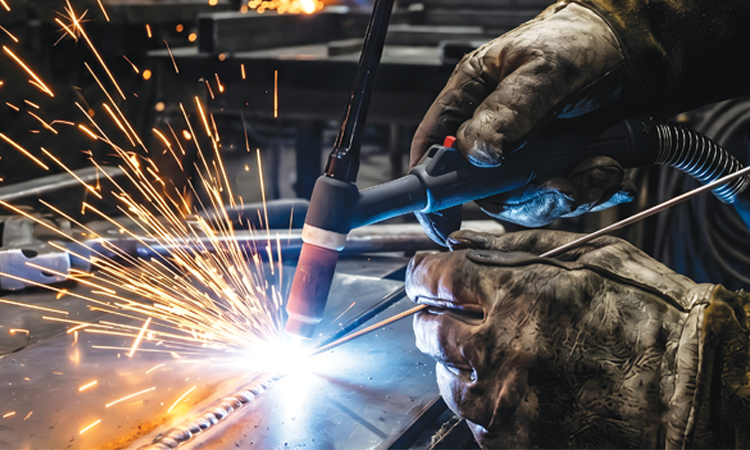
Modern engineering increasingly demands the combination of materials with different properties. A component may require the strength and heat resistance of one metal, the corrosion resistance of another, or the low weight and high conductivity of a third. This has made welding of dissimilar metals an important manufacturing technology across sectors such as automotive, aerospace, power generation, chemical processing, oil & gas, shipbuilding and general engineering.
Unlike conventional welding, where similar materials are joined, dissimilar-metal welding involves metals that differ significantly in chemical composition, melting point, thermal conductivity, coefficient of thermal expansion, electrical conductivity or metallurgical characteristics. These differences make the welding process more challenging, but when properly controlled, it can produce reliable and economically attractive joints.
Why Weld Dissimilar Metals?
The primary objective is to combine the best characteristics of two different materials in a single assembly. For example, stainless steel may be joined to carbon steel to provide corrosion resistance only where it is required, while aluminium may be joined to steel to reduce component weight.
In power plants and high-temperature equipment, dissimilar joints can connect components made from different grades of steels selected for their individual temperature and pressure capabilities. In automotive applications, aluminium-to-steel joining can help manufacturers reduce vehicle weight while retaining structural strength.
Dissimilar-metal welding can therefore eliminate the need to manufacture an entire component from an expensive material. It can also enable innovative product designs and improve overall material utilisation.
Key Challenges
The biggest challenge is the metallurgical compatibility of the two materials. When dissimilar metals melt and mix during welding, they may form brittle intermetallic compounds or other undesirable phases. These can significantly reduce joint strength and ductility.
Differences in melting temperatures also complicate the process. One metal may melt readily while the other remains solid or begins to overheat. Similarly, differences in thermal conductivity can cause uneven heat distribution and make control of the weld pool difficult.
Another major concern is the difference in coefficient of thermal expansion. During heating and cooling, the two metals expand and contract at different rates. This can generate residual stresses, distortion and, in severe cases, cracking.
Galvanic corrosion is another consideration, particularly when two dissimilar metals are exposed to moisture or aggressive environments. The weld region and heat-affected zones may have electrochemical characteristics different from those of the parent metals.
Selection of the Welding Process
The choice of welding process depends on the material combination, component geometry, required joint strength and production volume.
Gas Tungsten Arc Welding (GTAW/TIG) is widely used because it provides precise control of heat input and weld-pool characteristics. It is particularly suitable for critical joints and relatively thin sections.
Gas Metal Arc Welding (GMAW/MIG/MAG) offers higher productivity and is useful for production applications. Modern power sources with synergic and pulsed modes allow better control of heat input and metal transfer.
Laser welding is increasingly attractive for dissimilar-metal applications because its concentrated heat source produces a narrow weld and small heat-affected zone. Precise control of beam position and energy can minimise excessive mixing between the materials.
Electron beam welding provides deep penetration with very low overall heat input and is used for specialised aerospace, power and high-performance applications.
Other techniques, including friction welding, friction stir welding, brazing and diffusion bonding, can be particularly advantageous where conventional fusion welding creates unacceptable metallurgical problems.
Managing the Interface
One of the most important considerations is controlling the composition of the weld metal. Excessive dilution between the two parent materials can create undesirable phases. The selection of an appropriate filler metal can help produce a more compatible weld chemistry.
In some applications, a buffer or buttering layer is deposited on one of the parent materials before the final joint is made. This intermediate layer modifies the chemical and metallurgical environment at the joint and can reduce the risk of cracking or brittle phase formation.
Joint design is equally important. The thicknesses of the two materials, welding position, bevel geometry and location of the fusion boundary can all influence heat flow and dilution. In certain applications, controlling the weld interface so that the molten pool interacts preferentially with one material can improve joint performance.
Heat Input and Preheating
Careful control of heat input is essential. Excessive heat can increase dilution, promote undesirable metallurgical transformations and enlarge the heat-affected zone. Insufficient heat, on the other hand, can result in incomplete fusion or inadequate penetration.
Preheating may be required for some material combinations to reduce thermal gradients and the risk of cracking. Interpass temperature must also be controlled, particularly when welding alloys whose properties are sensitive to thermal cycles.
Modern welding power sources increasingly provide programmable control of current, voltage, pulse characteristics and travel speed. These capabilities help manufacturers establish repeatable welding procedures for challenging material combinations.
Examples of Dissimilar-Metal Applications
One common combination is carbon or low-alloy steel with stainless steel. Such joints are used extensively in process equipment, pipelines, heat exchangers and power-generation systems.
Aluminium-to-steel joining is more challenging because of their substantially different melting behaviour and the tendency to form brittle iron-aluminium intermetallic compounds. Nevertheless, specialised processes such as laser welding, friction welding and mechanical-assisted joining have created opportunities in automotive and transportation applications.
Copper-to-steel combinations are encountered in electrical, thermal and engineering applications. Copper’s high thermal conductivity can rapidly remove heat from the weld zone, requiring careful process optimisation.
Nickel alloys may also be joined to steels in high-temperature and corrosive-service equipment, where the combination provides a balance between cost and performance.
Automation and Quality Assurance
As dissimilar-metal welding becomes more sophisticated, automation is playing an increasingly important role. Robotic welding systems can maintain consistent torch position, travel speed and process parameters, reducing variations between operators and components.
Sensors and machine vision can monitor joint alignment, weld-pool behaviour and surface conditions. Advanced systems can also record welding parameters for traceability and quality control.
Non-destructive testing remains essential for critical applications. Radiography, ultrasonic testing, dye penetrant testing and magnetic-particle inspection can be selected according to the materials and joint configuration. Metallographic examination and hardness testing may also be required during procedure qualification.
The Road Ahead
The future of dissimilar-metal welding lies in better process control, advanced filler materials, hybrid welding technologies and digital manufacturing. Laser-arc hybrid welding, adaptive robotic systems and real-time sensing are enabling manufacturers to control heat input and weld characteristics with greater precision.
Computational modelling is also helping engineers predict thermal behaviour, residual stresses and metallurgical transformations before production begins. This reduces trial-and-error during process development.
As industries pursue lightweight structures, improved energy efficiency and greater material performance, the need to combine different metals will continue to grow. Welding of dissimilar metals, once regarded as a specialised challenge, is consequently becoming a strategic manufacturing capability.
The key to success is not simply making two different metals stick together, but engineering the interface between them. With appropriate material selection, joint design, process control, filler-metal selection and inspection, dissimilar-metal welding can deliver durable joints while unlocking the performance and economic advantages of combining different materials.