
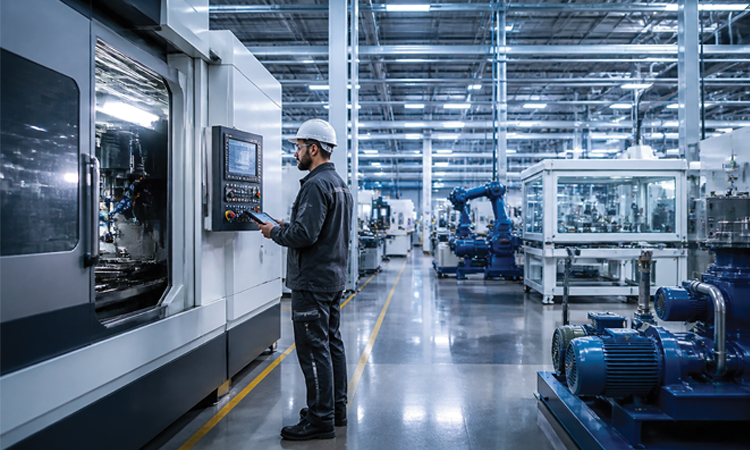
In today’s highly competitive manufacturing environment, productivity is closely linked to the reliability and availability of industrial equipment. Machines are expected to operate for longer hours, at higher speeds and with greater precision, while downtime, defects and operating costs must be kept to a minimum. In this environment, industrial maintenance is no longer merely a support function-it is a strategic business activity that directly influences productivity, profitability, safety and competitiveness. Industrial maintenance encompasses the inspection, servicing, repair, replacement and optimisation of machines, production systems, utilities and infrastructure. From CNC machine tools, robots and conveyors to compressors, pumps, electrical systems and process equipment, effective maintenance ensures that critical assets perform consistently throughout their operating life.
Ensuring Equipment Reliability
The most fundamental objective of industrial maintenance is to keep equipment in reliable working condition. Even a highly sophisticated machine can become a source of significant losses if it suffers frequent breakdowns.
Unexpected failures can bring an entire production line to a standstill. The resulting costs may include lost production, emergency repairs, overtime, delayed deliveries and potential damage to other equipment. Regular inspection and servicing can identify deteriorating components before they fail, allowing corrective action to be taken during planned shutdowns.
Maintenance therefore transforms equipment management from a reactive activity into a proactive strategy. A well-maintained machine is more predictable, easier to operate and less likely to cause unplanned interruptions.
From Preventive to Predictive Maintenance
Traditional preventive maintenance involves servicing equipment at predetermined intervals. Lubrication, filter replacement, belt inspection, bearing replacement and electrical checks are typical examples. While this approach is effective, it may sometimes result in components being replaced before they have reached the end of their useful life.
The emergence of predictive maintenance has changed this equation. Sensors and monitoring systems can continuously track parameters such as vibration, temperature, pressure, current consumption and acoustic emissions. Changes in these parameters can indicate developing faults.
For example, vibration analysis can reveal bearing deterioration or shaft misalignment, while thermal monitoring can identify abnormal electrical connections or overheating components. Maintenance teams can then intervene based on the actual condition of the asset rather than relying exclusively on a calendar-based schedule.
The Role of Industry 4.0
Digitalisation is taking industrial maintenance to another level. Connected machines can transmit operating information to central monitoring platforms, enabling maintenance teams to observe equipment health in real time.
Industrial Internet of Things (IIoT) technologies allow data from multiple machines to be collected and analysed. Cloud platforms and edge computing can process this information, while artificial intelligence and machine-learning algorithms can identify patterns associated with equipment failure.
This makes it possible to move towards condition-based and predictive maintenance. Instead of asking, “When should this machine be serviced?”, manufacturers can increasingly ask, “What is the machine telling us about its current condition?”
Digital twins can further enhance this capability by creating virtual representations of physical assets. By comparing actual operating data with expected performance, engineers can identify deviations and investigate potential problems.
Improving Productivity and OEE
Maintenance has a direct relationship with Overall Equipment Effectiveness (OEE), which considers equipment availability, performance and quality.
A machine that frequently breaks down has poor availability. A machine operating below its designed speed has reduced performance. Equipment that produces defective components because of wear, misalignment or incorrect calibration affects the quality component of OEE.
Consequently, maintenance is not simply about preventing breakdowns. It is about maintaining equipment at its optimum operating condition.
Proper alignment, lubrication, calibration, tooling condition and control-system performance can all contribute to higher machine productivity and more consistent output.
Enhancing Workplace Safety
Maintenance also has a crucial role in industrial safety. Faulty electrical systems, damaged guards, leaking hydraulic lines, defective pressure systems or worn mechanical components can create serious hazards.
A systematic maintenance programme ensures that safety-critical equipment is regularly inspected and maintained. Emergency stops, interlocks, sensors, protective guards, fire-protection systems and electrical installations must all remain functional.
Importantly, maintenance itself must be conducted safely. Lockout/tagout procedures, isolation of energy sources, appropriate personal protective equipment and authorised work practices are essential when servicing machinery.
Thus, effective maintenance protects both the equipment and the people who operate it.
Extending Asset Life
Industrial machinery represents a substantial capital investment. Manufacturers naturally seek to maximise the return from these assets.
Regular maintenance can extend equipment life by preventing premature wear and detecting problems before they develop into major failures. Proper lubrication, for example, can significantly influence the service life of bearings, gears and other moving components.
Similarly, maintaining correct alignment can prevent excessive loads on motors, couplings and shafts. Maintaining cooling systems can prevent overheating and deterioration of electrical and electronic components.
Asset longevity therefore depends not only on the original quality of a machine but also on how systematically it is maintained throughout its working life.
Controlling Maintenance Costs
At first glance, maintenance may appear to be an additional operating expense. However, the cost of not maintaining equipment can be considerably higher.
Emergency breakdowns often require expensive spare parts, urgent transportation and specialised technicians. They may also disrupt production schedules and affect customer commitments.
Planned maintenance allows manufacturers to budget expenses, stock critical spares and schedule manpower efficiently. Predictive maintenance can further reduce unnecessary component replacement by identifying exactly where intervention is required.
The objective is therefore not to minimise maintenance expenditure at any cost, but to achieve the optimum balance between maintenance cost, equipment reliability and production performance.
Towards Smart Maintenance
The future of industrial maintenance is increasingly data-driven, connected and intelligent. Artificial intelligence, wireless sensors, remote monitoring, digital twins and advanced analytics will enable manufacturers to anticipate failures with greater accuracy.
Maintenance systems will increasingly integrate with production planning and enterprise software, allowing spare parts, manpower and shutdown schedules to be coordinated automatically.
The ultimate objective is a manufacturing environment where equipment problems are identified and addressed before they affect production.
Conclusion
Industrial maintenance is fundamental to the success of modern manufacturing. It improves equipment reliability, increases productivity, enhances safety, reduces operating costs and extends asset life. More importantly, it provides manufacturers with greater control over their production processes.
As factories become smarter and more connected, maintenance will evolve from a largely reactive activity into a predictive and strategic function. Companies that invest in appropriate technologies, skilled personnel and disciplined maintenance practices will be better positioned to achieve higher uptime, consistent quality and sustainable competitiveness.
In modern industry, maintenance is not the cost of keeping machines running-it is the discipline that keeps the entire manufacturing system productive, safe and profitable.