

AUTOMATIONIs Robotic Automation a Mirage for SMEs?
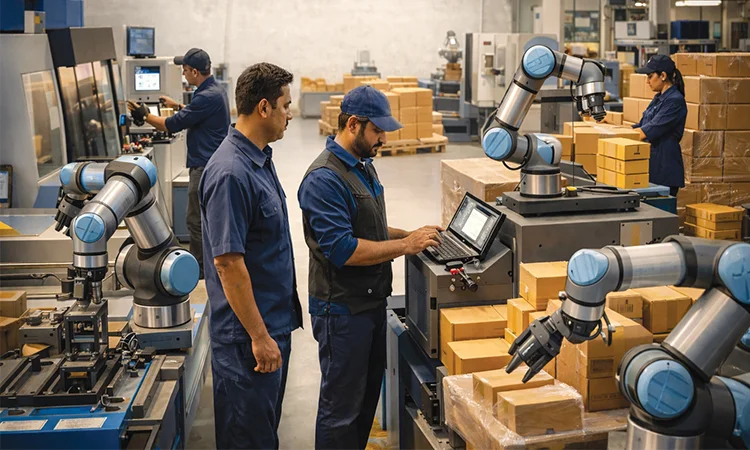
In an era increasingly shaped by digital transformation, smart factories, and Industry 4.0, robotic automation often appears to be the Holy Grail of manufacturing competitiveness. Headlines tout self-driving robots, automated assembly lines, and zero-defect production. Yet for small and medium-sized enterprises (SMEs), especially in emerging economies, the allure of robotics frequently raises a pressing question: Is robotic automation a mirage — expensive, elusive, and out of reach? Or is it a practical, economically justified strategy that SMEs can adopt to thrive?
This article explores the cost realities, strategic benefits, barriers, and viable roadmaps for SMEs considering robotic automation, with a balanced focus on affordability without compromising competitiveness.
The Promise of Robotic Automation
Robotic automation encompasses the deployment of programmable machines — articulated robots, collaborative robots (cobots), automated guided vehicles (AGVs), vision-guided systems, and more — to perform repetitive, precise, or hazardous tasks. In theory, automation offers:
• Higher productivity through continuous operation
• Improved quality and repeatability
• Lower labor dependency
• Enhanced workplace safety
• Data-driven process insights
Large enterprises with deep capital reserves have aggressively adopted robots, particularly in sectors like automotive, electronics, and pharmaceuticals. But for SMEs, the calculus is not as straightforward.
Affordability: The Core Constraint
The perception of automation as prohibitively expensive stems from several cost factors:
1. High Initial Capital Expenditure
Industrial robots and automation cells can cost anywhere from US$20,000 to >US$200,000 per unit (and significantly more for specialized systems). For an SME with tight margins, such outlays can strain cash flow.
2. Integration and Commissioning Costs
Robots are not plug-and-play. They often require:
• Custom fixtures and tooling
• Safety enclosures and interlocks
• Integration with conveyors, PLCs, and MES
• Skilled engineering support
These costs can easily rival or exceed the hardware cost.
3. Training and Skill Development
Operators and maintenance staff must be trained to program, maintain, and troubleshoot robots — an additional investment in time and money.
4. Maintenance and Lifecycle Costs
Like any asset, robots need periodic maintenance, firmware updates, and occasional parts replacement — all adding to total cost of ownership.
But Is It a Mirage? The Value Side of the Equation
Affordability debates often focus on out-of-pocket expense, overlooking the value delivered over time. When assessed holistically, automation can be far more affordable than it appears.
1. Labor Cost Savings and Availability
In many markets, labor costs are rising and skilled operators are in short supply. Robots deliver consistent throughput without fatigue, which can translate into real cost savings over a 5–7-year horizon.
2. Quality and Waste Reduction
Robotic processes — especially in welding, machine tending, and assembly — can achieve higher consistency and lower defect rates than manual operations, reducing rework and warranty costs.
3. Throughput and Lead Time Improvements
Automation can enable faster cycle times, shorter lead times, and more reliable delivery schedules — all of which strengthen competitiveness.
4. Safety, Compliance, and Risk Mitigation
Robots can take on hazardous jobs such as heavy lifting, grinding, and sanding, lowering the risk of accidents — a cost often underestimated in financial models.
Where the Myth Starts: Misaligned Expectations
Many SMEs hesitate because they assume automation must look like a fully autonomous factory with zero human involvement. That’s a myth.
Reality 1: Partial and Incremental Automation Works
SMEs can benefit enormously from task-level automation, such as:
• Robotic machine tending
• Pick-and-place cells
• Vision-assisted inspection
• Palletizing and packaging
• Welding and deburring
These deployments are significantly cheaper than full line automation and provide strong ROI.
Reality 2: Collaborative Robots (Cobots) Lower Barriers
Cobots — designed to work alongside humans — are typically:
• Lower cost
• Easier to program
• Safer without heavy guarding
Cobots are often the sweet spot for SMEs seeking automation without massive capital expense.
Affordability Strategies for SMEs
Rather than dismiss automation as unattainable, SMEs can pursue pragmatic strategies that align with their financial and operational realities:
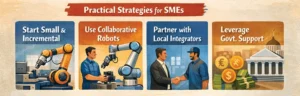
1. Start with High-Impact, Low-Complexity Cells
Identify processes where:
• Cycle times are long
• Labor intensity is high
• Quality variance is significant
Common candidates include:
• CNC machine tending
• Welding booths
• Sanding/grinding stations
• Packaging and palletizing
These applications often pay back in 12–24 months.
2. Choose Modular, Scalable Systems
Instead of monolithic custom cells:
• Use modular robot kits
• Choose plug-and-play end-of-arm tools
• Select systems that can be reconfigured for new products
Modularity reduces upfront costs and extends usable life.
3. Partner with Local Integrators
Systems integrators with domain experience can greatly reduce both integration risk and cost. SMEs should:
• Choose integrators with proven case studies
• Negotiate fixed-price implementation
• Seek shared risk models
Some integrators even offer pay-per-use or lease financing.
4. Leverage Government and Industry Support
Many governments, industry associations, and export promotion councils offer:
• Subsidies for automation investment
• Tax incentives
• Low-interest loans
• Training support
Accessing these schemes can dramatically improve affordability.
5. Embrace Digital Twins & Simulation
Before committing capital, SMEs can use digital simulation tools to:
• Visualize workflows
• Assess cycle time gains
• Identify bottlenecks
• Validate ROI
Simulation reduces guesswork and improves decision confidence.
6. Build Internal Skills Gradually
Rather than outsourcing everything:
• Train super-users in robot programming basics
• Use vendor training programs
• Create small “automation cells” for learning
This internal capability reduces long-term dependence on external support.
Challenges That Must Be Managed
Affordability is only one side of the automation story. SMEs must also address:
1. Change Management
Human resistance to automation must be actively managed through transparent communication and reskilling.
2. Data and Connectivity
To fully leverage automation, SMEs may need:
• PLC and sensor integration
• MES connectivity
• Data analytics dashboards
These add complexity but unlock performance visibility.
3. Cybersecurity
Connected automation systems must be secured against cyber threats, which requires governance and technical safeguards.
Robotic Automation in SMEs — Real Examples of ROI and Impact
A. SMEW Textile Machinery (Ahmedabad) — Cobot Boosts Output & ROI
Industry: Textile machinery
Solution: Deployment of a collaborative robot (UR10) for pick-and-place tasks in a constrained shop floor area.
Results:
• Productivity increased by ~300% after automation.
• Achieved return on investment within one year of installation.
• Automation enabled the company to evolve from an MSME to an SME with expanded production capability.
• This example highlights how task-specific automation — even with a single cobot — can be affordable and transformative for smaller manufacturers.
B. Sri Sai Markers and Engravers — Better Quality & Lower Rejections
Industry: Precision engraving and spray painting for automotive components
Solution: A collaborative robot (UR5) integrated for automated spray painting and handling in a confined area.
Results:
• Sharp reduction in product rejection and rework within two months.
• Cobots enhanced quality and were deployed safely alongside human operators.
• Workers retained employment and were upskilled rather than displaced.
This case shows how even small deployment areas and confined spaces — typical in SMEs — can benefit financially and operationally through collaborative automation.
C. Sri Lakshmi Agro Foods (Udhaiyam Dhall) — Packaging & Demand Surge
Industry: Food processing & packaging
Solution: UR5 cobot for secondary packaging tasks.
Results:
• Consistent productivity during peak demand periods (e.g., holidays).
• Enhanced throughput with minimal additional labour.
• Female workforce supported with safer, less physically strenuous tasks.
This demonstrates how robotics can help SMEs manage demand spikes without undergoing full line automation.
Some More Case Studies and Lessons
1. New Engineering Works, Jamshedpur — Scaling with Cobots
Company: New Engineering Works (Jharkhand)
Industry: Precision machining for automotive and industrial components
Automation: Deployment of six collaborative robots (cobots) for CNC machine tending and auxiliary tasks
Impact:
• Cobots enabled extended production hours, helping the SME run 24×7 operations.
• The company achieved a 40% growth in output after automation adoption.
• Staff were upskilled — jobs were not replaced but augmented, with workers handling higher-value tasks while cobots handled repetitive work.
Learning: Cobots can be integrated within limited floor space and deliver strong ROI even for SMEs with constrained budgets, making automation practical rather than a distant ideal.
2. Craft and Technik Industries (CATI), Pune — Precision, Quality, and Exports
Company: Craft and Technik Industries, Pune
Industry: Precision components (mainly for automotive and exports)
Automation: UR10 cobot used for CNC machine tending and quality inspection
• Outcome:
• Achieved 15–20% increase in production capacity.
• Over 40,000 parts produced with zero customer rejections after cobot deployment.
• Cobots helped CATI improve delivery reliability for export markets while keeping staff engaged in oversight and higher-value tasks.
Learning: Even for precision-oriented SMEs, cobots can enhance quality and throughput without massive capital spending.
3. Shruti Engineers — Small Shop, Big Impact
Company: Shruti Engineers (10-person MSME)
Industry: Precision components
Automation: Single UR10 cobot for CNC machine tending
Impact:
• Productivity increased from ~300 parts/day to ~400 parts/day.
• Operators learned cobot programming quickly — within a day — highlighting that SMEs can adopt robotics without deep prior expertise.
• Automation helped the SME remain competitive and improve on-time delivery.
Learning: Accessible robotics (like cobots) can deliver measurable gains even in very small SME setups.
4. SMEW Textile Machinery, Ahmedabad — High ROI in Pick-and-Place
Company: SMEW Textile Machinery (Ahmedabad)
Industry: Textile machinery components
Automation: UR10 cobot for pick-and-place operations
Results:
• ~300% improvement in output within one year.
• The investment paid back within 12 months, moving the company from MSME status toward a larger operational scale.
• Cobots fit into constrained floor space — a typical SME challenge — while boosting consistency.
Learning: Focused automation for repetitive tasks can yield dramatic productivity improvements and quick payback, bringing automation within SME affordability.
5. Sri Sai Markers & Engravers — Shop Floor Quality Gains
Company: Sri Sai Markers & Engravers
Industry: Automotive components, spray painting tasks
Automation: Cobot for spray painting and handling
Impact:
• Reduced wastage and improved consistency in spray coating operations.
• Cobots were programmed by in-house staff, demonstrating that SMEs can build internal automation skills without heavy external dependency.
• Quality expectations from larger OEM customers were met more reliably.
Learning: Task-specific cobot deployment can address quality challenges, even in traditionally manual processes like painting and surface preparation.
Key Affordability Insights for Indian SMEs
i. Low-Cost Robotics Models Exist
Cobots and modular robots are inherently less expensive and simpler to integrate than traditional industrial robots with extensive safety caging. Many Indian SMEs have adopted models costing a fraction of a full industrial cell, making automation feasible within tighter budgets.
ii. Training and Upskilling Pay Dividends
Small teams often learned basic programming quickly, sometimes within a day of deployment, lowering reliance on external specialists and reducing long-term costs.
iii. Affordable Integration and Local Support
Local system integrators and vendors are increasingly packaging cobots with software and safety systems suitable for SME environments, reducing integration costs and making automation adoption smoother.
iv. Producing Value, Not Just Technology
Automation is less about replacing labor and more about enabling consistent quality, higher throughput, and better capacity utilization — outcomes that translate into real financial value, even for smaller manufacturers.
Challenges SME Robots Still Face in India
While the case studies are encouraging, hurdles remain:
• High upfront cost perceptions: Robots are still seen as expensive unless SMEs evaluate total cost of ownership and payback periods.
• Lack of flexible financing: Unlike software subscriptions, hardware often has to be purchased outright — though rental or leasing options are slowly emerging.
• Awareness gap: Many SME owners still perceive automation as complex or irrelevant to their scale without understanding modular paths.
Conclusion: Not a Mirage — Just a Measured Choice
These Indian SME case studies clearly show that robotic automation is neither a distant fantasy nor an unaffordable luxury. With the right task-specific cobot deployments, modular integration, and incremental investment approach, SMEs in India are already reaping measurable gains in productivity, quality, and competitiveness.
Automation doesn’t have to mean a full robotic line or huge capital deployment — for Indian manufacturing SMEs, it means starting small, solving specific bottlenecks, and generating real economic value that justifies the investment.