
Programmable Safety at the Core of Intralogistics Automation : ReeR Safety and Metalprogetti
Automation in intralogistics pushes machines to operate faster, in tighter spaces, and increasingly in direct interaction with human operators. In this context, safety cannot be treated simply as a regulatory layer: it becomes a core element of system design, shaping performance, flexibility, and reliability. This design philosophy underpins the collaboration between the Italian company Metalprogetti and ReeR Safety, chosen as the technological partner for the safety architecture of several machines in Metalprogetti’s portfolio.
Founded in 1980, Metalprogetti designs and manufactures automated systems for the handling and storage of hanging garments, folded clothing, and lightweight products, with installations worldwide across sectors such as fashion logistics, industrial laundry, and distribution. The company produces hundreds of systems each year, distinguished by modular architecture, mechanical reliability, and a strong focus on process optimization. Within this engineering philosophy, safety is considered an integral part of machine design rather than a downstream constraint.
Integration between automation and safety
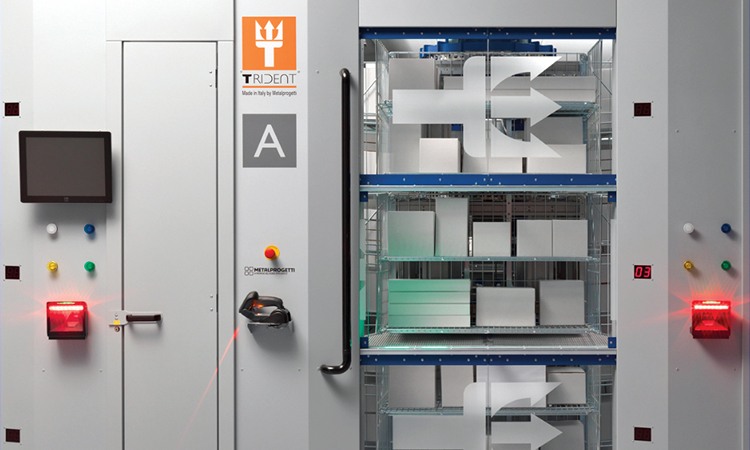
Among the systems that best represent this integration between automation and safety is Trident, a modular, multi-level horizontal rotating warehouse developed by Metalprogetti for the automated storage and retrieval of garments and lightweight products. The system is based on stacked carousels equipped with baskets and designed to allow simultaneous picking and refilling operations, bringing products directly to the operator to reduce movement and improve productivity.
Because the installation includes continuous moving parts, independent operating levels, and multiple access points for operators and maintenance personnel, safety management becomes particularly complex. To address this, each Trident system integrates several safety devices, each associated with different machine responses.
The long sides of the installation are protected by fixed guards, while access to the carousels is provided through transparent sliding doors monitored by safety magnetic sensors, which stop only the associated carousel when opened. Maintenance access doors between modules are equipped with separate-actuator safety switches that safely stop all carousels facing the affected corridor. The system also includes perimeter safety ropes that intervene in case of product fall or misplacement, and emergency stop buttons distributed across the workstations capable of halting the entire installation.
The combination of multiple safety devices and the need to manage selective, partial, or global machine stops made it necessary to adopt a programmable, scalable, and easily diagnosable safety control solution.
Why Mosaic: when complexity requires intelligent control
After previously adopting traditional safety solutions, robust but bulky and limited in flexibility, Metalprogetti selected the Mosaic Safety Controller Platform from ReeR Safety as the safety control architecture for Trident.
The platform allowed engineers to overcome previous limitations related to panel space, wiring complexity, and configuration management. The implemented architecture includes two Mosaic M1 safety controllers, installed in the main electrical cabinet and operating independently, each responsible for one half of the machine. The controllers exchange only a limited number of electrotechnical signals, while most safety signals are collected in the field and transmitted via the MCT safety bus.
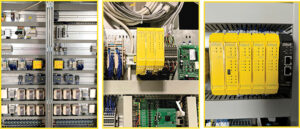 Each controller is equipped with expansion modules:
- MCT2 module for connection to field devices through the MCT bus
- Three MOR4 modules for managing Safe Torque Off (STO) signals of the drives
- One MBEP module enabling Profinet communication with the PLC, allowing identification of the type and location of an emergency event
Above each operator workstation, a remote interface box is installed containing input modules connected to the Mosaic controller via the MCT bus:
- MCT2 module for bus communication with the Mosaic M1 and another remote box
- MI12T8 module for devices requiring short-circuit monitoring
- MI8 module for managing additional safety signals
This architecture enables safety signals to be collected locally and transmitted efficiently to the central cabinet, drastically reducing wiring complexity, cabinet size, and installation time.
Tangible benefits across the machine lifecycle
The adoption of the Mosaic platform has generated measurable advantages throughout the entire machine lifecycle.The modular architecture optimizes panel space, simplifies assembly operations, and accelerates commissioning. Clear diagnostic functions help technicians quickly identify wiring or configuration errors, minimizing downtime. From a design perspective, the possibility to manage heterogeneous safety devices through a centralized programmable platform gives Metalprogetti the flexibility to adapt Trident to different system configurations without redesigning the entire safety architecture.
Safety as a design enabler
The Trident case clearly illustrates how safety in advanced automation systems should not be viewed as a compliance requirement alone. When integrated intelligently, safety systems can improve machine efficiency, reliability, and overall engineering quality. Through the Mosaic platform, ReeR Safety has provided Metalprogetti with a compact, scalable, and robust solution capable of managing a complex distributed safety architecture without compromising performance.