

Automation in Electronics Manufacturing : Powering Productivity, Precision, and Scale
How Automation Is Reshaping Speed, Quality & Scale in Electronics

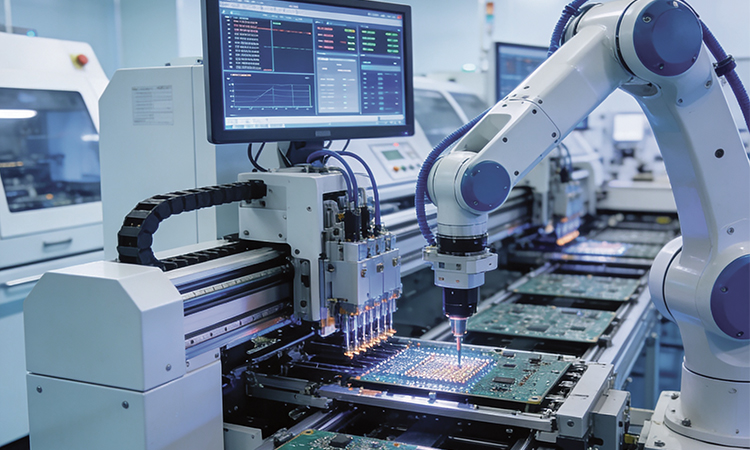
The electronics industry stands at the forefront of technological advancement, driving innovation across sectors ranging from consumer devices and automotive systems to telecommunications and industrial automation. As product complexity increases and time-to-market shrinks, manufacturers are under constant pressure to deliver high-quality products at scale while maintaining cost efficiency. In this demanding landscape, automation has emerged as a cornerstone of productivity enhancement, transforming traditional manufacturing paradigms into highly efficient, data-driven ecosystems.
The Need for Automation in Electronics Manufacturing
Electronics manufacturing is inherently complex, involving intricate processes such as printed circuit board (PCB) assembly, component placement, soldering, inspection, and testing. These processes require extreme precision, consistency, and speed-attributes that are difficult to achieve through manual operations alone. Rising consumer expectations, shorter product life cycles, and increasing customization further compound the challenge. Automation addresses these issues by streamlining operations, reducing human error, and enabling manufacturers to scale production without compromising quality. In a sector where even microscopic defects can lead to product failure, automation ensures repeatability and reliability at every stage.
Enhancing Throughput with High-Speed Automation
One of the most significant contributions of automation is the dramatic improvement in throughput. Advanced pick-and-place machines, automated optical inspection (AOI) systems, and robotic assembly lines can operate at speeds far exceeding human capabilities. Modern surface mount technology (SMT) lines, for instance, can place tens of thousands of components per hour with exceptional accuracy. This not only accelerates production but also minimizes bottlenecks, ensuring a smooth and continuous workflow. Automated material handling systems further enhance efficiency by ensuring the timely delivery of components to various stages of production. The result is a substantial increase in output without a proportional increase in labor costs—an essential factor in maintaining competitiveness in a global market.
Precision and Quality Assurance
In electronics manufacturing, precision is paramount. Automation eliminates variability associated with manual operations, ensuring consistent quality across large production volumes. Robotic systems equipped with advanced vision technologies can perform tasks such as component alignment, soldering, and inspection with micron-level accuracy. Automated inspection systems, including AOI and automated X-ray inspection (AXI), play a crucial role in quality assurance. These systems can detect defects such as misaligned components, solder bridges, and voids in real time, enabling immediate corrective action. This not only reduces rework and scrap rates but also enhances overall product reliability. Furthermore, closed-loop feedback systems allow machines to self-correct, continuously improving process accuracy and reducing deviations over time.
Reducing Operational Costs
While the initial investment in automation can be substantial, the long-term cost benefits are significant. Automation reduces dependency on manual labor, minimizes errors, and decreases material wastage. It also lowers the costs associated with rework, returns, and warranty claims. Energy-efficient automated systems contribute to cost savings by optimizing power consumption during production. Additionally, predictive maintenance enabled by smart automation reduces downtime and extends the lifespan of equipment, further improving return on investment. In regions where labor costs are rising, automation provides a viable solution to maintain cost competitiveness without compromising productivity.
Flexibility and Scalability
Contrary to the traditional perception of automation as rigid and inflexible, modern automated systems are highly adaptable. Flexible manufacturing systems (FMS) allow manufacturers to switch between different product variants with minimal downtime. This is particularly important in the electronics industry, where product diversity and customization are increasing. Programmable robots and modular production lines enable quick reconfiguration, making it easier to respond to changing market demands. Automation also supports scalable production, allowing manufacturers to ramp up output during peak demand periods without significant operational disruptions. This flexibility ensures that manufacturers can remain agile in a fast-evolving industry landscape.
Integration with Industry 4.0 Technologies
Automation in the electronics industry is increasingly intertwined with Industry 4.0 technologies such as the Industrial Internet of Things (IIoT), artificial intelligence (AI), and data analytics. Smart factories leverage interconnected systems to monitor, analyze, and optimize production processes in real time. Sensors embedded in machines collect vast amounts of data, which can be analyzed to identify inefficiencies, predict equipment failures, and optimize production schedules. AI-driven algorithms can enhance decision-making by providing actionable insights, enabling manufacturers to achieve higher levels of productivity. Digital twins—virtual replicas of physical production systems—allow manufacturers to simulate and optimize processes before implementing them on the shop floor, reducing risks and improving efficiency.
Workforce Transformation
Automation is not about replacing human workers but redefining their roles. In the electronics industry, automation has led to the emergence of a more skilled workforce focused on programming, monitoring, and maintaining automated systems. Operators are increasingly required to have technical expertise in areas such as robotics, data analysis, and system integration. This shift necessitates investment in training and upskilling to ensure that the workforce can effectively manage and leverage automated technologies. By reducing repetitive and labor-intensive tasks, automation allows workers to focus on higher-value activities, fostering innovation and improving overall productivity.
 Challenges in Implementing Automation
Despite its numerous benefits, the adoption of automation in the electronics industry is not without challenges. High initial capital investment can be a barrier, particularly for small and medium enterprises (SMEs). Integrating new automated systems with existing infrastructure can also be complex and time-consuming. There is also a need for standardization and interoperability to ensure seamless communication between different systems and devices. Cybersecurity concerns are another critical issue, as increased connectivity exposes manufacturing systems to potential cyber threats. Addressing these challenges requires strategic planning, investment in robust infrastructure, and collaboration between technology providers and manufacturers.
Sustainability and Environmental Impact
Automation contributes to sustainability by optimizing resource utilization and reducing waste. Precise material handling and process control minimize scrap and improve yield rates. Energy-efficient machines and smart energy management systems further reduce the environmental footprint of manufacturing operations. In addition, automation supports the adoption of environmentally friendly manufacturing practices, such as lead-free soldering and efficient recycling processes. As sustainability becomes a key priority for the electronics industry, automation will play a vital role in achieving environmental goals.
The Road Ahead
The future of automation in the electronics industry is poised for continued growth, driven by advancements in robotics, AI, and connectivity. Collaborative robots (cobots), which can work alongside human operators, are expected to gain prominence, offering a balance between automation and human flexibility. The integration of advanced technologies will enable the development of fully autonomous production systems capable of self-optimization and real-time decision-making. As these technologies mature, the gap between design and production will continue to narrow, enabling faster innovation cycles and improved product quality.
Conclusion
Automation has become indispensable in the electronics industry, enabling manufacturers to meet the dual demands of productivity and precision. By enhancing throughput, ensuring quality, reducing costs, and enabling flexibility, automation is reshaping the manufacturing landscape. As the industry continues to evolve, the adoption of advanced automation technologies will be critical to maintaining competitiveness and driving sustainable growth. For manufacturers willing to embrace this transformation, automation offers not just a pathway to improved productivity, but a strategic advantage in an increasingly dynamic and demanding market.