

Are We Harnessing Tidal Power Adequately?
India’s 7,517 km coastline is more than just a vast geographical boundary—it is a massive reservoir of kinetic potential, waiting to be tapped. As the world accelerates its transition to cleaner energy, oceans have emerged as one of the most reliable, predictable, and sustainable sources of renewable power. Despite this, tidal energy—often called blue energy—remains one of India’s most underutilized resources. The question, therefore, is both simple and urgent: Are we harnessing tidal power adequately? The answer, at present, is a clear no. But the opportunities are immense, the technologies are maturing, and the time for action is now.
Understanding Tidal Power: The Predictable Renewable
Among all renewable energy sources, tidal power is unique for one powerful reason—predictability.
Unlike solar or wind, tidal cycles follow precise astronomical patterns influenced by the Moon’s gravitational pull. This allows grid planners to forecast energy generation decades in advance, making tidal power extremely reliable.
The Two Main Methods
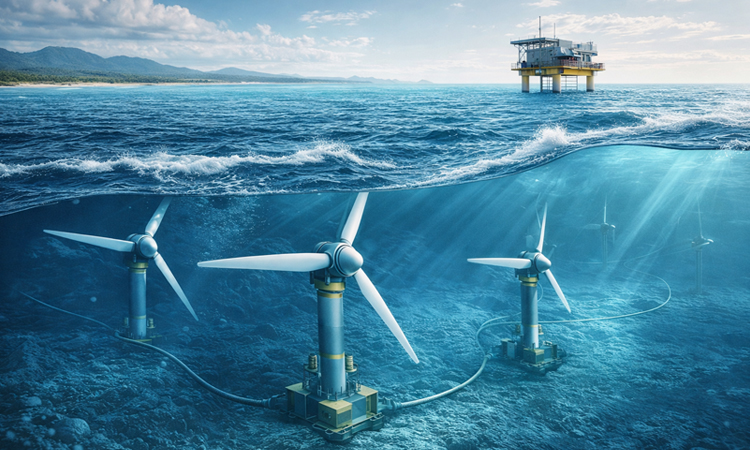
- Tidal Stream Systems – Underwater turbines placed in fast-moving tidal currents.
- Tidal Barrages / Lagoons – Dams built across estuaries that trap and release water through turbines.
Both methods convert the natural rise and fall of ocean tides into electricity.
India’s Tidal Power Potential: A Sleeping Giant
Several studies by the Ministry of New and Renewable Energy (MNRE), National Institute of Ocean Technology (NIOT), and global consultants indicate substantial tidal power potential in India.
Key High-Potential Zones
- Gulf of Kutch (Gujarat) – 1,200 to 1,800 MW potential
- Gulf of Khambhat (Gujarat) – 7,000 to 8,000 MW potential
- Sunderbans (West Bengal) – 100 MW potential
- Little Andaman & other island clusters – smaller but strategic potential
Combined, India’s theoretical potential exceeds 9,000 MW—a sizeable contribution to the country’s renewable energy goals. Yet India currently has zero operational tidal power projects.
Why Has India Not Explored Tidal Power Aggressively?
Despite its advantages, tidal power faces several roadblocks in India.
- High Capital Costs
Building underwater turbines or barrages requires specialised materials, corrosion protection, and robust engineering. Start-up capital is significantly higher than wind or solar.
- Limited Commercial Demonstration
The technology is still emerging globally. Few commercial-scale plants exist, making banks and investors cautious.
- Environmental Concerns
Barrages can alter sedimentation patterns, fish migration, and coastal ecosystems. Environmental clearances can take time.
- Competing Renewables
India has aggressively pursued solar and wind due to falling prices. These have overshadowed emerging technologies like tidal energy.
- Lack of Domestic Manufacturing Ecosystem
India currently imports most advanced tidal turbines and control systems. Without local manufacturing, costs remain high.
- Regulatory and Policy Gaps
Tidal energy was only recently included under the renewable energy umbrella.
Incentives, tariffs, and frameworks are still evolving.
The Global Picture: Where the World Is Heading
Several countries are aggressively moving forward with tidal energy pilots and commercial projects.
United Kingdom
Home to the world’s most advanced tidal stream projects—MeyGen in Scotland being a flagship example.
South Korea
Sihwa Lake Tidal Power Station (254 MW) is currently the largest tidal power plant in the world.
France & Canada
Both are pioneering tidal turbines and lagoon systems.
China
Investing heavily in tidal lagoons and floating tidal platforms.
The key takeaway: The world believes in tidal power. India cannot afford to be a bystander.
The Case for Tidal Power in India: Why It’s Worth Pursuing
India’s coastal advantages, energy deficit, and decarbonization commitments make tidal power not just viable, but necessary.
A) Predictable, Baseload Renewable Power
Tidal power offers firm power—something solar and wind cannot always guarantee. This strengthens grid stability.
B) Energy Security & Self-Reliance
Harnessing ocean energy reduces dependence on imported fossil fuels.
C) Coastal Development Opportunity
Tidal plants bring infrastructure, jobs, and industrial capacity to coastal districts.
D) Ideal for Islands & Remote Areas
Andaman & Nicobar Islands, Lakshadweep, and isolated coastal communities can benefit from decentralised marine energy.
E) Climate Commitments
India aims for 500 GW non-fossil fuel capacity by 2030. Blue energy can complement solar, hydro, and wind.
Promising Projects That Never Took Off
Several tidal energy proposals in India made headlines but did not progress.
Gulf of Kutch Tidal Plant (Gujarat)
A 50 MW pilot project with a global technology partner was conceptualised but later dropped due to high initial costs.
Sunderbans Pilot
A small demonstration was studied but not executed due to techno-economic constraints.
Khambhat Tidal Barrage Plan
A massive project linking the two banks of the Gulf, doubling as infrastructure, was studied extensively but was eventually shelved.
These stalled initiatives highlight one key point: India needs risk-sharing mechanisms and innovation funding to unlock tidal energy.
Technologies Are Evolving—Costs Are Falling
The story of wind and solar showed how rapidly renewable technologies can become cost-effective when adopted at scale. The same trajectory is expected for tidal power.
New Advances Include:
- Direct-drive turbines with fewer moving parts
- Floating tidal platforms (easy to deploy & maintain)
- Modular turbines for shallow waters
- Anti-corrosion materials and coatings
- AI-based tidal flow prediction and control
- Hybrid solar–tidal microgrids
- Reduced installation cost via offshore-wind-style logistics
As technology matures, costs are expected to fall by 40–60% in the next decade.
What India Must Do to Catch Up
India is at a turning point where tidal energy can become part of its future renewable portfolio. To unlock this potential, several actions are essential:
1. Create Marine Energy Zones (MEZs)
Similar to solar parks, coastal regions with strong tidal currents should be demarcated for marine energy clusters.
2. Incentivize Pilot Projects
Government-backed demonstration plants of 5–20 MW can reduce investor risk and build local expertise.
3. Build a Domestic Manufacturing Ecosystem
Partnerships with international players can jump-start turbine and subsea systems manufacturing.
4. Promote Hybrid Renewable Projects
Solar + Tidal + Battery microgrids can be game changers for islands and coastal belts.
5. Enhance Marine Environmental Frameworks
Sustainable development guidelines must ensure minimal disturbance to sensitive ecosystems.
6. Collaborate Internationally
Learning from the UK, South Korea, Norway, and Canada can accelerate India’s capability curve.
7. Develop Skilled Workforce
Marine engineers, oceanographers, offshore specialists, and energy technologists must be trained.
8. Long-Term Tariff Support
Feed-in tariffs or viability-gap funding can attract private players.
Gulf regions in India have massive potential—running into thousands of megawatts.
Conclusion: A Future Waiting Beneath the Waves
India’s coastline is more than a natural boundary—it is a powerhouse waiting to be tapped. Tidal energy is clean, predictable, indigenous, and perfectly aligned with India’s long-term energy and climate goals. While challenges exist, they are not insurmountable. What is required is vision, coordinated policy support, technological partnership, and the willingness to invest in long-term energy security.
With global technologies maturing and climate pressures rising, India stands at the threshold of a blue-energy revolution.
The question is no longer “Can we harness tidal power?” It is: “Will we choose to?”
Tidal Power — Quick Facts & Myths
FACTS
- Tidal cycles are predictable for centuries.
- Turbines operate underwater, unaffected by weather.
- Blue energy operates at high capacity factors (up to 40%).
- Ideal for islands, estuaries, and remote grids.
MYTHS
- “Tidal power is too expensive.”
It is costly today, but so were wind and solar before scale. Costs are falling as technology improves. - “Tidal turbines harm marine life.”
With proper design and siting, impacts can be minimal. Studies show fish adapt quickly to low-speed turbines. - “It cannot produce large volumes of power.”
Gulf regions in India have massive potential—running into thousands of megawatts.