


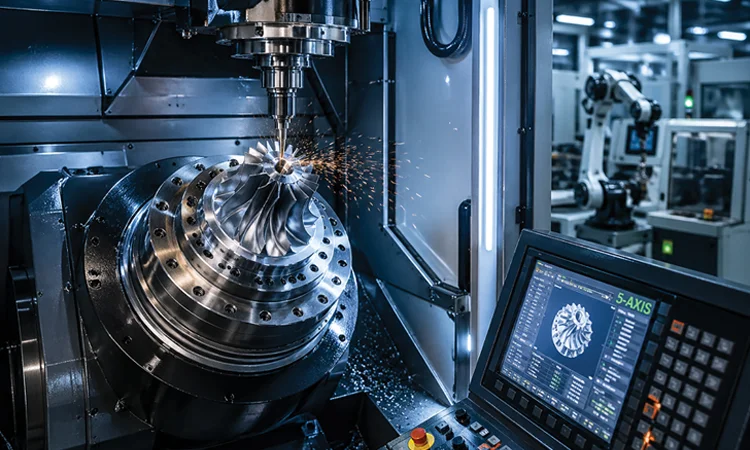
In modern manufacturing, precision, efficiency, and flexibility are essential for staying competitive. Among the many technologies that enable these attributes, rotary tables play a vital role in enhancing machining capabilities and improving productivity. Widely used in CNC machining centers and automation systems, rotary tables enable multi-axis operations, allowing manufacturers to produce complex components with high accuracy and minimal setup time.
Understanding Rotary Tables A rotary table is a mechanical device that allows a workpiece to rotate about a fixed axis, enabling machining operations from multiple angles without the need for repositioning. Typically mounted on CNC machining centers, these tables provide an additional axis of motion, commonly referred to as the fourth axis (or even fifth axis when combined with tilting mechanisms).
By rotating the workpiece precisely, rotary tables allow tools to access different surfaces, making it possible to perform complex machining operations in a single setup. This capability significantly enhances efficiency and reduces manual intervention.
Types of Rotary Tables
Rotary tables come in various configurations, each suited for specific applications:
1. Horizontal Rotary Tables
These are mounted horizontally and are commonly used in milling and drilling operations. They are ideal for machining circular patterns, slots, and equally spaced features.
2. Vertical Rotary Tables
Mounted vertically, these tables are often used for operations such as gear cutting and contour machining. They provide flexibility in handling different workpiece orientations.
3. Tilting Rotary Tables
Also known as trunnion tables, these can rotate and tilt, enabling five-axis machining. This allows for highly complex geometries to be machined in a single setup.
4. Direct-Drive Rotary Tables
These use torque motors instead of traditional gear mechanisms, offering higher precision, faster response, and minimal backlash. They are increasingly popular in high-end machining applications.
Enhancing Precision and Accuracy
One of the most significant advantages of rotary tables is their ability to improve precision. By enabling accurate positioning of the workpiece, these tables ensure that machining operations are performed exactly as programmed.
High-quality rotary tables are equipped with advanced encoders and feedback systems that provide precise angular positioning. This ensures repeatability and consistency across multiple production cycles. In industries such as aerospace and medical device manufacturing, where tolerances are extremely tight, rotary tables are indispensable.
Additionally, direct-drive rotary tables eliminate backlash, further enhancing accuracy and ensuring smooth, vibration-free operation.
Boosting Productivity and Efficiency
Rotary tables significantly enhance productivity by reducing the need for multiple setups. Traditionally, machining complex parts required repositioning the workpiece multiple times, leading to increased setup time and potential errors.
With a rotary table, multiple operations can be performed in a single setup, minimizing downtime and improving throughput. This capability is particularly valuable in high-volume production environments, where efficiency is critical.
Furthermore, rotary tables enable simultaneous machining operations in multi-axis systems, reducing cycle times and maximizing machine utilization.
Enabling Multi-Axis Machining
The integration of rotary tables with CNC machines enables multi-axis machining, which is essential for producing complex geometries.
In four-axis machining, the rotary table provides an additional rotational axis, allowing the workpiece to be indexed or continuously rotated during machining. In five-axis systems, tilting rotary tables enable even greater flexibility, allowing tools to approach the workpiece from virtually any angle.
This capability is crucial for manufacturing intricate components such as turbine blades, impellers, and complex molds, where traditional machining methods would be inefficient or impractical.
Applications Across Industries
Rotary tables are used across a wide range of industries, demonstrating their versatility and importance:
- Aerospace: Machining of complex components such as turbine blades and structural parts
- Automotive: Production of engine components, transmission parts, and precision assemblies
- Medical Devices: Manufacturing of implants and surgical instruments with high precision
- Tool and Die: Creation of molds, dies, and intricate tooling components
- General Engineering: Drilling, milling, and contouring operations in various applications
In all these sectors, rotary tables help achieve high precision, improved efficiency, and consistent quality.
Integration with Automation and Smart Manufacturing
Modern rotary tables are increasingly integrated with automation systems and Industry 4.0 technologies. Advanced control systems allow seamless communication between the rotary table and the CNC machine, enabling synchronized operations.
Sensors and feedback devices provide real-time data on position, speed, and performance, allowing for monitoring and optimization. Predictive maintenance capabilities further enhance reliability by identifying potential issues before they lead to failures.
Such integration transforms rotary tables into intelligent components of smart manufacturing systems, contributing to improved productivity and reduced downtime.
Improving Flexibility and Reducing Setup Time
Flexibility is a key advantage of rotary tables. Manufacturers can quickly adapt to different workpieces and machining requirements by simply reprogramming the system.
This reduces the need for specialized fixtures and manual adjustments, saving time and effort. Quick changeover capabilities are particularly beneficial in industries that require frequent production changes or customization.
By minimizing setup time and enabling efficient handling of diverse tasks, rotary tables support agile manufacturing processes.
Challenges and Considerations
Despite their benefits, rotary tables come with certain challenges. Proper alignment and calibration are essential to ensure accuracy and performance. Any misalignment can lead to errors in machining and affect product quality.
The selection of the right type of rotary table is also critical. Factors such as load capacity, speed, accuracy, and compatibility with the CNC machine must be carefully considered.
Maintenance is another important aspect. While advanced rotary tables are designed for durability, regular inspection and servicing are necessary to maintain optimal performance.
The Future of Rotary Tables
The future of rotary tables is driven by technological advancements and increasing demand for precision and efficiency. Innovations such as direct-drive systems, advanced materials, and improved control algorithms are enhancing performance and reliability.
The integration of artificial intelligence and data analytics is expected to further improve functionality, enabling adaptive control and real-time optimization.
As manufacturing continues to evolve towards automation and digitalization, rotary tables will play an even more significant role in enabling complex machining operations and improving overall productivity.
Conclusion
Rotary tables are a cornerstone of modern machining, enabling manufacturers to achieve high precision, efficiency, and flexibility. By facilitating multi-axis operations and reducing setup time, they significantly enhance productivity and product quality.
As industries continue to adopt advanced manufacturing technologies, the importance of rotary tables will only grow. For manufacturers seeking to stay competitive in a dynamic global market, investing in high-quality rotary table systems is a strategic decision that delivers long-term benefits.