

Additive Manufacturing Market Size to Reach USD 215.49 Billion by 2034 at a 23.9% CAGR from 2026 to 2034 : Polaris Research Report
How 3D printing is redefining the future of industrial manufacturing

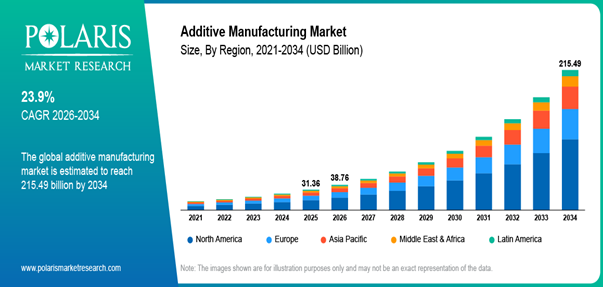
The global additive manufacturing market is rapidly transforming the Chemicals & Materials industry as manufacturers increasingly adopt advanced 3D printing technologies to improve efficiency, reduce waste, and accelerate innovation. The market, valued at USD 31.36 billion in 2025, is projected to reach USD 215.49 billion by 2034, expanding at an impressive CAGR of 23.9% during the forecast period. The rapid shift toward digital manufacturing, lightweight material production, and customized industrial applications is positioning additive manufacturing as a core technology across aerospace, healthcare, automotive, energy, and industrial manufacturing sectors.
Additive manufacturing, commonly referred to as industrial 3D printing, enables manufacturers to create components layer-by-layer directly from digital models. Unlike traditional subtractive manufacturing methods that remove material from larger blocks, additive manufacturing significantly reduces raw material waste while offering exceptional design flexibility and precision. This capability is becoming increasingly valuable for the Chemicals & Materials industry, where demand for advanced polymers, metal powders, ceramics, and composite materials continues to rise.
The growing focus on lightweight and high-performance materials is one of the major growth drivers shaping the global additive manufacturing market. Aerospace and automotive manufacturers are actively integrating additive manufacturing technologies to produce lightweight components that improve fuel efficiency and reduce emissions. Complex geometries that were previously impossible or highly expensive to manufacture using conventional methods can now be produced with greater accuracy and lower material consumption.
The healthcare industry is also emerging as a major contributor to additive manufacturing market expansion. Customized implants, prosthetics, dental devices, and surgical tools are increasingly being produced using advanced 3D printing systems. Medical manufacturers are leveraging additive manufacturing to create patient-specific solutions that improve treatment outcomes and reduce production lead times. The growing use of biocompatible materials and precision manufacturing technologies is expected to further accelerate healthcare adoption worldwide.
According to industry analysis, rapid prototyping remains one of the strongest application areas driving additive manufacturing adoption. Companies across multiple industries are increasingly utilizing industrial 3D printing to shorten product development cycles, reduce prototyping costs, and improve design testing capabilities. Manufacturers can now quickly develop functional prototypes and tooling components without relying on expensive molds or lengthy production processes. This flexibility is helping businesses accelerate innovation while improving operational agility.
Material innovation continues to play a central role in the expansion of the additive manufacturing ecosystem. Advanced polymers, metal alloys, ceramics, and composite materials are enabling broader industrial applications across high-performance environments. Metal additive manufacturing, in particular, is gaining substantial traction in aerospace, defense, and industrial machinery applications where strength, durability, and precision are critical. The development of cost-effective, high-performance printing materials is expected to remain a major competitive factor across the industry.
The integration of Industry 4.0 technologies is further strengthening market growth prospects. Artificial intelligence, machine learning, automation, and digital twin technologies are increasingly being combined with additive manufacturing systems to improve production efficiency and predictive maintenance capabilities. Smart factories are utilizing digital manufacturing platforms to optimize workflows, enhance product customization, and reduce operational downtime. This convergence of advanced manufacturing technologies is reshaping industrial production strategies worldwide.
Regionally, North America currently maintains a dominant position in the global additive manufacturing market due to strong aerospace investments, advanced industrial infrastructure, and widespread technology adoption. The United States remains a leading hub for additive manufacturing innovation, supported by significant investments in aerospace, healthcare, defense, and automotive industries. Major manufacturers across the region are actively expanding production capabilities and investing in next-generation industrial 3D printing technologies.
Meanwhile, Asia Pacific is emerging as the fastest-growing regional market. Countries such as China, Japan, South Korea, and India are witnessing rising investments in industrial automation, electronics manufacturing, and digital production technologies. Expanding manufacturing infrastructure and growing government support for smart manufacturing initiatives are creating significant growth opportunities for additive manufacturing solution providers throughout the region.
Europe is also experiencing strong market momentum due to increasing emphasis on sustainable manufacturing practices and advanced engineering applications. Automotive manufacturers and industrial equipment producers across Germany, France, Italy, and the United Kingdom are increasingly adopting additive manufacturing to improve supply chain efficiency and product innovation. The region’s strong focus on reducing material waste and carbon emissions aligns closely with the advantages offered by industrial 3D printing technologies.
The competitive landscape of the additive manufacturing market remains highly dynamic as companies continue to invest in research, product development, and strategic partnerships. Leading market participants include Stratasys, 3D Systems, EOS GmbH, GE Additive, HP Inc., Desktop Metal, Markforged, and Materialise NV. These companies are actively introducing advanced printing platforms, intelligent software solutions, and high-performance materials designed for industrial-scale manufacturing environments.
Recent industry developments further highlight the accelerating pace of innovation within the market. Companies are expanding metal additive manufacturing capabilities, launching advanced material solutions, and increasing investments in aerospace and defense applications. The rising adoption of sustainable manufacturing technologies and decentralized production models is expected to create additional long-term opportunities for the global additive manufacturing industry.
Despite its strong growth trajectory, the market faces challenges related to high equipment costs, material expenses, and scalability limitations for mass production. However, ongoing advancements in printer speed, material availability, and automation technologies are expected to gradually overcome these barriers. As industries increasingly prioritize digital transformation, sustainability, and supply chain resilience, additive manufacturing is poised to become a cornerstone of next-generation industrial production.
The future of the global additive manufacturing market remains highly promising as businesses continue to embrace customized manufacturing, rapid prototyping, and advanced material engineering. The growing convergence of AI-driven design, smart manufacturing systems, and innovative material science will continue driving the evolution of additive manufacturing across the Chemicals & Materials industry and beyond.