

Engineering HMI Systems for Regulated Environments : From Compliance to Operational Performance
In Pharma, Your HMI Isn't Just a Screen, It's a Compliance Record

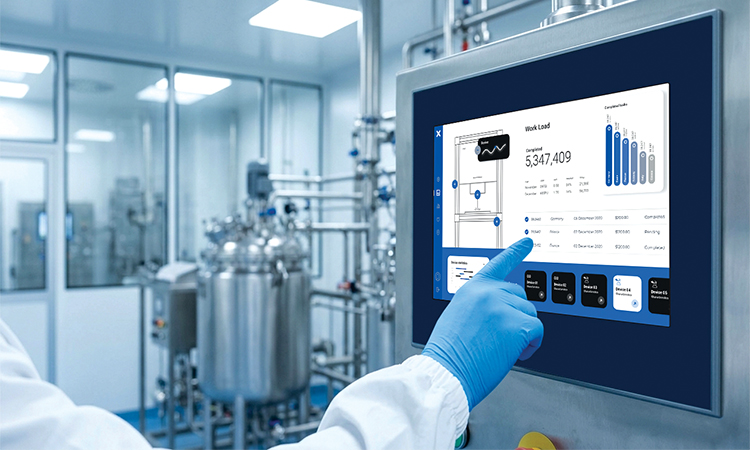
In highly regulated industries such as pharmaceutical manufacturing, technology is expected to do more than perform. It must also demonstrate compliance, reliability and traceability at every stage of production. Exor India Pvt. Ltd., as the Indian subsidiary of the Italian Exor International spa, supports OEMs and system integrators in addressing these challenges by combining industrial hardware and software technologies designed for modern automation environments. In this context, Human-Machine Interfaces (HMIs) are no longer simple visualization tools. They have become a critical layer where operational control, data integrity and user interaction con-verge. Designing HMI systems for regulated environments therefore requires a careful balance between compliance, performance and usability.
When compliance shapes system design
Pharmaceutical production environments impose strict requirements on how data is generated, managed and accessed. Every action must be traceable. Every parameter must be recorded. Every user interaction must be controlled. This fundamentally changes the role of HMI systems.
Features such as:
• audit trails
• role-based access control
• secure data handling
• traceability of operations are no longer optional. They are part of the system architecture.
Modern HMI frameworks have evolved to support these requirements natively, enabling machine builders to design applications where compliance is embedded directly into the interface layer.
Bridging OT and IT in pharmaceutical production
One of the most significant shifts in industrial automation is the convergence between Opera-tional Technology (OT) and Information Technology (IT).
Production systems are increasingly connected to :
• centralized databases
• enterprise platforms
• cloud-based services
•remote monitoring environments
In this scenario, the HMI becomes a bridge between machine-level operations and higher-level data systems. With the evolution of platforms such as JMobile 4.7, this integration becomes more structured and accessible. The ability to connect industrial protocols with IT infrastructures allows data to move seamlessly across systems while maintaining consistency and control. For example, centralized user management through technologies like LDAP enables authentication to be handled at IT level, while the HMI enforces operational roles and permissions. This sep-aration improves traceability and aligns system behavior with the expectations of regulated envi-ronments.
Structuring data beyond the machine
In regulated industries, data must not only be generated — it must be structured, stored and made available over time. Local storage alone is not sufficient. Modern HMI platforms now support direct interaction with databases, enabling production data, alarms and operational events to be transferred automatically into centralized systems. Capabilities such as automated database integration allow system designers to define how and when data is collected and stored, without requiring complex custom development.
This ensures that:
• production data is consistently structured
• critical information is preserved
• traceability is maintained across the entire process
By simplifying the connection between OT data and IT infrastructures, these technologies reduce complexity while increasing reliability.
Security as part of system architecture
As industrial systems become more connected, cybersecurity is no longer a separate layer — it becomes part of system design.
HMI platforms are now required to support:
• controlled user authentication
• secure communication mechanisms
• protected software updates
• system hardening practices
Recent developments in HMI technologies reflect this shift. Features such as encrypted update packages, signed deployments and advanced access control mechanisms contribute to building more secure and reliable systems. In regulated sectors like pharmaceuticals, this is particularly relevant. System integrity is directly linked to both compliance and operational continuity.
Performance and usability in real operations
While compliance and security are essential, systems must remain practical for daily use. Operators work in environments where clarity, responsiveness and ease of interaction are criti-cal.
HMI platforms must therefore ensure:
• intuitive user interfaces
• responsive visualization
• efficient navigation
• adaptability to different workflows
The evolution of solutions such as JMobile continues to focus on improving user experience while maintaining the robustness required by industrial environments.
From HMI software to engineering platform
The role of HMI technology is expanding.
What was once a standalone tool is now part of a broader ecosystem that includes:
• data management
• connectivity
• control integration
• system lifecycle considerations
In this context, platforms like JMobile act as engineering environments that support the develop-ment of scalable and future-ready automation systems. They enable machine builders and system integrators to design solutions that are not only func-tional, but also aligned with the increasing demands of digitalized and regulated production envi-ronments.
Engineered for compliance. Designed for performance.
In pharmaceutical manufacturing, compliance and performance cannot be treated as separate objectives.
Systems must be designed to ensure that:
• data is reliable and traceable
• processes are controlled & transparent
• operators can work efficiently
• technologies remain secure over time
Achieving this balance requires more than individual features. It requires a consistent engineer-ing approach across hardware, software and system architecture. And in industries where every parameter matters, that approach becomes a defining factor.