

Welding for Production & Productivity
Welding Is No Longer Just Joining Metal, It's Driving Your Bottom Line

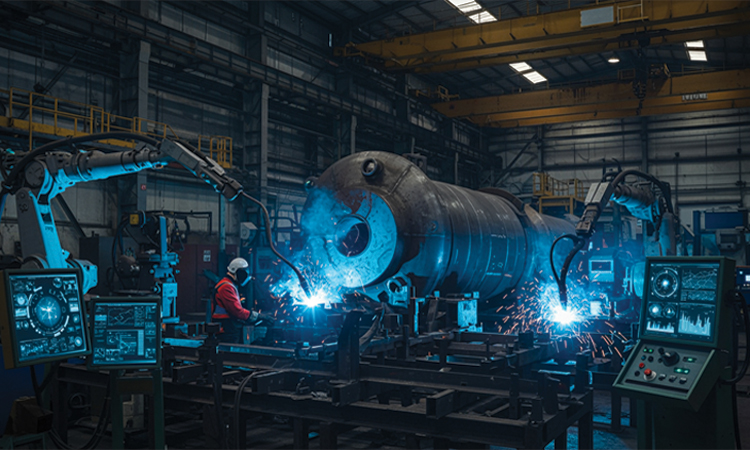
In the contemporary manufacturing environment, welding has evolved from being a basic fabrication activity to a strategic manufacturing process that directly influences productivity, cost efficiency, structural integrity, and product quality. Across industries such as automotive, railways, shipbuilding, oil and gas, power generation, aerospace, and heavy engineering, welding determines how efficiently materials are joined, how reliably structures perform in service, and how competitively products can be manufactured.
As production volumes increase and quality expectations tighten, welding technologies are being continuously refined to deliver higher deposition rates, faster cycle times, improved repeatability, and lower defect rates, while also addressing concerns related to energy consumption, workforce availability, and sustainability.
Welding as a Productivity Enabler
Welding contributes to productivity in multiple ways. By enabling permanent, high-strength joints, it eliminates the need for additional fasteners, reduces material usage, and allows designers greater freedom in component geometry. Modern welding processes minimize post-weld machining, distortion, and rework—factors that directly impact manufacturing throughput and cost.
In high-volume manufacturing, welding speed and consistency are critical. In heavy fabrication, the focus shifts to deposition efficiency, weld quality, and long-term reliability. Across all these scenarios, the right welding process, combined with automation and digital controls, becomes a key determinant of production performance.
Conventional Welding Processes and Their Role
Shielded Metal Arc Welding (SMAW)
SMAW, or stick welding, remains one of the most widely used welding processes, particularly in construction, maintenance, and field fabrication. Its simplicity, low equipment cost, and ability to operate in outdoor environments make it indispensable, even though it is relatively slow and operator-dependent.
While SMAW may not be the most productive process in factory settings, it plays a vital role where flexibility and accessibility are more important than speed.
Gas Metal Arc Welding (GMAW / MIG)
GMAW is one of the most significant contributors to industrial productivity. With continuous wire feed, stable arcs, and compatibility with automation, MIG welding enables high deposition rates and consistent weld quality.
It is extensively used in automotive manufacturing, structural fabrication, and general engineering. Pulsed and synergic variants further improve control, reduce spatter, and allow welding of thin materials at higher speeds.
Flux-Cored Arc Welding (FCAW)
FCAW bridges the gap between MIG welding and high-deposition processes. Its flux-filled wire improves penetration and weld metal properties, making it ideal for thick sections and outdoor applications.
With higher deposition rates than solid-wire MIG and better tolerance to wind and surface contamination, FCAW significantly enhances productivity in shipbuilding, bridges, and heavy fabrication.
Gas Tungsten Arc Welding (GTAW / TIG)
TIG welding is synonymous with precision and quality. While it is slower than other arc welding processes, its superior control makes it indispensable for critical components in aerospace, nuclear, pharmaceuticals, and food processing industries.
From a productivity standpoint, TIG welding contributes by reducing defects, rework, and failures, especially in high-value applications where quality outweighs speed.
High-Productivity Welding Processes
Submerged Arc Welding (SAW)
Submerged Arc Welding is one of the most productive welding processes for thick materials and long, continuous welds. In SAW, the arc burns beneath a blanket of granular flux, which protects the weld pool, stabilizes the arc, and allows extremely high currents to be used.
SAW delivers:
- Very high deposition rates
- Deep penetration and consistent weld quality
- Minimal spatter and arc radiation
These characteristics make it ideal for pressure vessels, pipelines, wind towers, shipbuilding, rail wagons, and large structural components. Multi-wire and tandem SAW systems further enhance productivity, making SAW a cornerstone process in heavy engineering industries.
Plasma Arc Welding (PAW)
Plasma Arc Welding is an advanced variant of TIG welding that uses a constricted arc to achieve higher energy density, deeper penetration, and better arc stability. PAW enables keyhole welding, allowing single-pass welds on thicker materials that would otherwise require multiple passes.
PAW is particularly valuable in:
- Aerospace components
- Stainless steel and nickel alloys
- Precision tube and pipe welding
Although equipment costs are higher, PAW delivers superior consistency and productivity in applications demanding tight tolerances and high-quality welds.
Resistance Welding
Resistance welding is one of the most productivity-driven welding processes in high-volume manufacturing, particularly in the automotive, appliance, and sheet-metal fabrication sectors. In this process, heat is generated by electrical resistance at the joint interface while pressure is applied through electrodes, eliminating the need for filler materials, fluxes, or shielding gases. Variants such as spot welding, seam welding, and projection welding offer extremely fast cycle times—often measured in fractions of a second—making resistance welding ideally suited for automated and robotic production lines. The process delivers consistent weld quality, low energy consumption per joint, and minimal post-weld finishing, all of which contribute directly to higher throughput and lower manufacturing costs. With advancements in inverter-based power sources, real-time weld monitoring, and adaptive control systems, modern resistance welding has become smarter, more reliable, and capable of handling advanced high-strength steels and lightweight materials used in today’s vehicles and appliances.
Laser Beam Welding (LBW)
Laser welding has emerged as a game-changing technology for high-speed, high-precision production. With extremely focused heat input, laser welding produces deep, narrow welds with minimal distortion.
Its advantages include:
- Very high welding speeds
- Minimal heat-affected zone
- Excellent suitability for automation and robotics
Laser welding is extensively used in automotive body-in-white manufacturing, battery welding for electric vehicles, electronics, and medical devices. Hybrid laser-arc welding further combines the benefits of deep penetration and gap-bridging capability.
Electron Beam Welding (EBW)
Electron Beam Welding offers unmatched penetration and precision by using a focused electron beam in a vacuum environment. It is capable of welding very thick sections in a single pass.
EBW is primarily used in:
- Aerospace and defense
- Nuclear and turbine components
- High-integrity critical structures
While limited to specialized environments, EBW contributes significantly to productivity by eliminating multiple welding passes and reducing post-weld processing.
Automation, Robotics, and Digital Welding
One of the most transformative developments in welding productivity has been the integration of automation and robotics. Robotic welding systems deliver consistent weld quality, higher arc-on time, and reduced dependence on manual labor.
Advanced robotic cells incorporate:
- Vision systems for seam tracking
- Adaptive control for variable joint conditions
- Offline programming for reduced setup time
Digital welding power sources with waveform control, pulsed operation, and synergic settings allow precise regulation of heat input, improving penetration and reducing defects.
Smart Welding and Industry 4.0
With Industry 4.0 gaining momentum, welding is becoming increasingly data-driven. Smart welding systems collect and analyze parameters such as current, voltage, wire feed speed, and temperature in real time.
These systems enable:
- Predictive maintenance of welding equipment
- Weld traceability for quality-critical applications
- Reduced downtime and improved process consistency
Digitalization is particularly important in regulated industries such as aerospace, railways, and pressure equipment manufacturing.
Consumables & Materials Innovation
Advances in welding consumables—such as low-hydrogen electrodes, metal-cored wires, and optimized fluxes—have further boosted productivity. These consumables improve deposition efficiency, weld metal properties, and ease of use, while reducing post-weld cleaning and repair. Similarly, improved shielding gas mixtures enhance arc stability and penetration, contributing to faster welding speeds and better bead profiles.
Conclusion
Welding plays a decisive role in determining production efficiency and manufacturing productivity. From conventional arc welding processes to high-deposition methods like SAW and advanced technologies such as plasma, laser, and electron beam welding, each process contributes uniquely to meeting modern manufacturing demands.
By carefully selecting the right welding process, adopting automation and digital controls, and investing in skilled personnel and consumable innovation, manufacturers can achieve higher throughput, superior quality, and long-term competitiveness. As industries continue to evolve, welding will remain both a foundational manufacturing technology and a powerful driver of productivity and progress.