

When designing complex safety systems, the real challenge today is not only to achieve the level of safety required by standards, but to do so in an efficient, scalable and sustainable manner in terms of space, costs and design time. MOSAIC M1 was created precisely for this purpose: to be the main module of a modular, flexible and expandable safety system, capable of managing even complex architectures with a large number of devices and safety relays.
Compared to traditional solutions based on relay modules, MOSAIC M1 enables a paradigm shift: fewer physical components, more software logic, greater control and ease of project evolution.
A compact controller for complex safety systems
MOSAIC M1 is the standard main module of the MOSAIC platform: it can be used both in stand-alone mode, for small machines, and as a master for controlling complex safety systems thanks to the management of expansion modules.
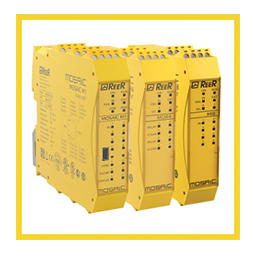
Its main features include:
• 8 digital inputs for safety sensors
• 2 inputs dedicated to restart and EDM• 2 pairs of OSSD safety outputs (PNP 400 mA)
• 2 configurable status outputs (PNP 100 mA)
•4 test outputs for short-circuit monitoring
• Field-bus interface for connection to MOSAIC expansion modules
This architecture allows functions that would require numerous relay modules with traditional solutions to be concentrated in a single device, with a significant impact on the size of the electrical panel.
Less space in the panel, more design freedom
One of the main advantages of MOSAIC M1 is the significant reduction in space occupied in the electrical panel.In traditional systems, managing multiple safety functions requires the use of numerous relays, complex wiring and dedicated power supplies. MOSAIC significantly reduces the number of electromechanical components, simplifying wiring and reducing panel construction time.This approach is particularly advantageous in systems that require the control of a large number of safety relays, where available space often becomes a critical constraint.
Expandability to grow with the machine
MOSAIC M1 is designed to accompany the evolution of the machinery over time. During the design phase or in subsequent phases, it is possible to add new safety sensors, divide the system into safety zones and expand the number of inputs and outputs through dedicated expansion modules.
In the MOSAIC system, expandability is not an optional extra, but a structural element: the M1 main module communicates via MSC bus with input and output expansion units, allowing the safety architecture to be adapted to actual application requirements without having to redesign the entire system or make major changes to the wiring.
Simple yet powerful software configuration
MOSAIC M1 is configured using Mosaic Safety Designer (MSD), the dedicated software provided free of charge that reduces the risk of errors, improves project traceability and automatically
 obtains the parameters needed to calculate the Performance Level (PFHd, DCavg, MTTFd) in accordance with ISO EN 13849-1 and EN 62061 standards.
The graphical interface allows the designer to:
• Define the safety logic intuitively
• Easily modify the project even in advanced stages
• Simulate and validate the operation of the logic
• Monitor the status of the system in real time during installation
From theory to practice: the Narita Techno application
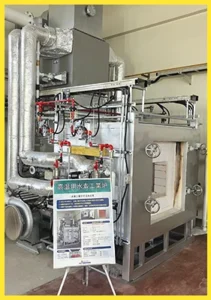
Narita Techno is a manufacturer specialising in industrial furnaces and gas burners, operating in the automotive, industrial, ceramics and R&D sectors. This case study concerns one of its most critical applications, that of hydrogen-fuelled industrial furnaces, where safety is a key element of the design.
During hydrogen combustion, the high flame speed can cause backfire phenomena. To prevent this, the pipes must be purged with inert gas (nitrogen) before ignition. Implementing this safety system with traditional hardware solutions would have required up to 16 safety relays for each burner, with a significant impact on the size of the electrical panel and the complexity of the architecture.
In this application, MOSAIC M1 was used as the master module, alongside dedicated expansion modules: the MI8 input unit and the MOR4 safety relay output module. This configuration clearly highlights the value of the MOSAIC modular architecture.
The MI8 module allows you to add 8 digital safety inputs, enabling the management of a large number of sensors and signals without the need for additional controllers or complex wiring between relays. The MOR4 module, on the other hand, provides software-configurable safety relay outputs with various configuration options (single or dual channel outputs) and feedback inputs for EDM monitoring.
Thanks to the combined use of M1, MI8 and MOR4, Narita Techno was able to create a highly articulated safety system while maintaining a small footprint in the electrical panel. An equivalent solution based on traditional relay modules would have required a significantly higher number of electromechanical components, resulting in increased space requirements, wiring time and potential for error.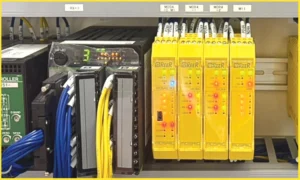
The choice of MOSAIC made it possible to:
• Significantly reduce the space occupied in the electrical panel thanks to the modular management and expandability of the system
• Simplify the design and validation of safety logic via software
• Manage a large number of safety inputs and outputs with a few compact modules
• Achieve compliance with Japanese standard JIS B8415
• Contain costs compared to the use of safety PLCs
The installation, carried out on a hydrogen-powered industrial furnace in Tokoname, demonstrates how MOSAIC M1, together with the MI8 and MOR4 expansion modules, is a concrete and effective solution even in highly complex and safety-critical applications.
A complex but, above all, replicable application case
The Narita Techno experience is not only a technically advanced application but also an easily replicable architectural model. As we have said, each individual burner would have required up to 16 dedicated safety relays with traditional solutions. In a multi-burner or multi-station scenario, this approach would lead to a linear (and unsustainable) increase in the number of components, cabling and space occupied in the electrical panel.With MOSAIC, the safety architecture changes radically: the M1 module acts as the logical heart of the system, while the functions are extended in a serial and modular way via MI8 and MOR4.
Adding a new burner or station does not require redesigning the entire system, but rather a controlled extension of the existing architecture.This approach makes MOSAIC particularly suitable for manufacturers of series machines, modular plants and multi-station systems, where safety standardisation and the ability to replicate proven designs represent a real competitive advantage.