

Economic Aspects of Welding: Beyond Joining Metals
Why the Real Cost of Welding Has Very Little to Do With Consumables

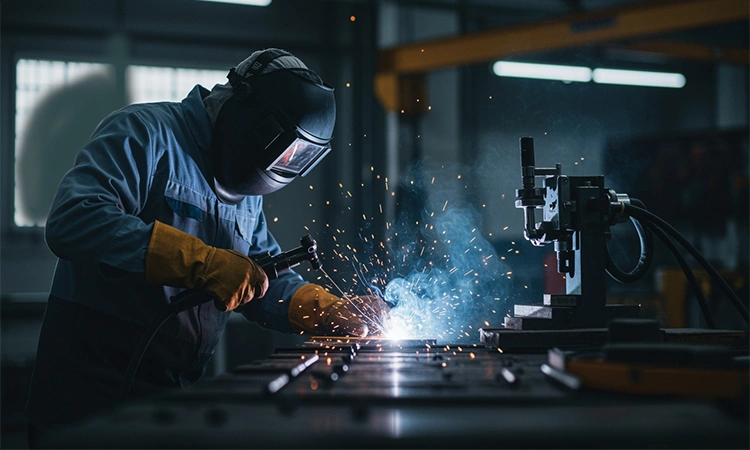
Welding is no longer a shop-floor activity confined to joining metals; it is a strategic manufacturing function with far-reaching economic implications. In sectors such as automotive, heavy engineering, shipbuilding, oil & gas, railways, and infrastructure, welding decisions directly influence productivity, cost efficiency, quality, safety, and lifecycle performance. As competition intensifies and margins tighten, understanding the economic aspects of welding has become indispensable for sustainable industrial growth.
Understanding the True Cost of Welding
The economics of welding extend well beyond visible expenses. While consumables and electricity are easy to quantify, the true cost of welding includes labour productivity, equipment utilisation, quality-related losses, downtime, training, and lifecycle performance.
A breakdown of typical welding costs reveals that labour constitutes the largest share—often 50–70 percent of total welding cost—followed by overheads, equipment depreciation, and consumables. This clearly indicates that productivity improvement and quality enhancement deliver greater economic benefits than merely reducing consumable prices.
Productivity as the Primary Economic Lever
Welding productivity is governed by factors such as deposition rate, arc-on time, joint design, and process efficiency. Manual welding methods, though flexible, suffer from low arc-on time and higher variability. In contrast, semi-automatic and automated processes significantly improve consistency and throughput.
Case Study 1: Structural Fabrication – FCAW vs SMAW
A mid-sized structural fabrication company executing industrial sheds and bridges relied predominantly on SMAW. Despite low consumable costs, the company faced high labour hours and frequent rework. After transitioning to Flux-Cored Arc Welding (FCAW) for fillet and groove welds, the results were striking:
• Deposition rate increased by nearly 45%
• Welding time per joint reduced by 35%
• Rework and slag-cleaning time reduced substantially
• Overall welding cost dropped by 22%.
Though FCAW consumables were more expensive, higher productivity and lower labour input delivered superior economics.
Capital Investment and Return on Investment (ROI)
Advanced welding equipment demands higher upfront investment, often leading to hesitation among small and medium enterprises. However, evaluating equipment based on lifecycle ROI rather than purchase price reveals a different picture. Modern inverter-based power sources, robotic welding systems, and laser welding machines offer better energy efficiency, consistent output, and reduced downtime. These advantages translate into predictable costs and faster payback periods in production environments.
Case Study 2: Automotive Supplier – Robotic GMAW Adoption
An automotive tier-1 supplier manufacturing chassis components faced challenges with inconsistent weld quality and rising labour costs. The company invested in robotic GMAW cells for repetitive weld joints.
Economic outcomes included:
• Labour cost reduction of 40 percent per component
• Weld rejection rate reduced from 3.5% to under 0.5%
• Cycle time reduced by 30 percent
• Payback period achieved within 18 months
This case underscores how automation, though capital-intensive, delivers long-term economic stability and competitiveness.
Labour Economics and Skill Constraints
The global shortage of skilled welders has become a serious economic concern. Escalating wages, high attrition, and skill variability increase production risk and costs. Mechanisation and automation address this challenge by reducing dependence on manual skills while improving consistency.
From an economic standpoint, deploying semi-automatic welding systems enables better utilisation of semi-skilled labour, optimising workforce costs without compromising quality.
Quality Economics and Cost of Non-Conformance
Poor weld quality leads to rework, scrap, delayed delivery, and reputational damage. The cost of correcting defects escalates sharply if detected late in the production or service lifecycle.
Case Study 3: Pressure Vessel Manufacturer – Investing in Quality Control
A pressure vessel manufacturer supplying equipment to the oil & gas sector experienced frequent repairs during hydrotesting due to weld defects. By investing in:
• Qualified Welding Procedure Specifications (WPS)
• Welder certification and training
• Advanced NDT techniques such as phased array UT
The company achieved:
• Reduction in rework by 60 percent
• Improved delivery timelines
• Lower inspection-related delays
• Enhanced customer confidence and repeat orders
The investment in preventive quality measures resulted in measurable economic gains by minimising the cost of non-quality.
Energy Consumption and Sustainability Economics
Energy efficiency is emerging as a critical economic parameter, particularly in large-scale fabrication facilities. Traditional transformer-based welding machines consume significantly more power compared to modern inverter systems.
Case Study 4: Heavy Engineering Shop – Energy-Efficient Welding Power Sources
A heavy engineering firm manufacturing large fabricated assemblies replaced legacy welding machines with inverter-based systems. The outcomes included:
• Power consumption reduced by 20–25 percent
• Improved arc stability leading to fewer defects
• Lower maintenance costs
• Compliance with internal sustainability goals
In addition to direct cost savings, the company benefited from improved ESG metrics and reduced carbon footprint—factors increasingly influencing business decisions and financing.
Consumables Selection: Economics Beyond Price
Consumable choice has a direct bearing on productivity, weld quality, and long-term performance. Low-cost consumables may increase hidden costs through spatter, poor slag removal, or higher defect rates.
Case Study 5: Rail Coach Fabrication – Low-Hydrogen Consumables
A rail coach manufacturer switched to low-hydrogen electrodes and wires for critical joints to mitigate cracking issues. Although consumable costs increased marginally, the benefits included:
• Elimination of hydrogen-induced cracking
• Reduced repair welding
• Improved structural integrity and service life
• Lower lifecycle maintenance costs
This case highlights the importance of evaluating consumables based on total cost of ownership, not just purchase price.
Automation, Digitalisation, and Predictive Economics
The integration of digital welding technologies—such as parameter monitoring, data logging, and predictive maintenance—adds a new dimension to welding economics. These systems enable manufacturers to monitor weld quality in real time, optimise consumable usage, and reduce unplanned downtime.
In high-value fabrication, digital traceability is no longer optional; it is an economic necessity that reduces risk and enhances compliance.
Lifecycle Economics of Welded Structures
The economic impact of welding extends well into the operational phase of a product. Superior weld quality reduces inspection frequency, repair costs, and downtime during service.
Case Study 6: Infrastructure Project – Lifecycle Cost Advantage
In a large infrastructure project
involving welded steel girders, the contractor adopted advanced welding procedures and stringent quality
control. Although fabrication costs were slightly higher, the structure demonstrated:
• Reduced corrosion-related failures
• Lower inspection and maintenance costs
• Extended service life
Over the project lifecycle, the total cost of ownership was significantly lower, validating the economic logic of investing in quality welding upfront.
Welding Economics as a Strategic Advantage
Today, welding economics influences competitiveness as much as design or material selection. Companies that adopt a holistic approach—balancing productivity, quality, energy efficiency, automation, and lifecycle performance—gain a decisive edge in cost, reliability, and market reputation.
Conclusion
The economic aspects of welding are complex, interconnected, and strategic in nature. True cost optimisation lies not in reducing individual expenses, but in enhancing productivity, ensuring consistent quality, and minimising lifecycle costs. As industries move toward automation, digitalisation, and sustainability, welding economics will continue to evolve—rewarding organisations that view welding not merely as a joining process, but as a core value-creating function.