
Summits Hygronics: Engineering Air and Gas Treatment Solutions for a Demanding Industry

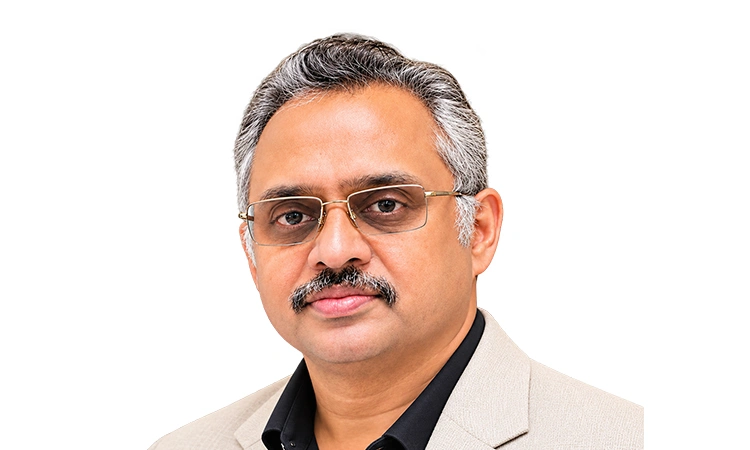
Director & Co-Founder,
Summits Hygronics Pvt. Ltd.
Since its inception in Coimbatore in 1996, Summits Hygronics Pvt. Ltd. has evolved into a comprehensive solutions provider in compressed air treatment, industrial gas generation and medical oxygen systems. With strong in-house engineering capabilities, a portfolio spanning standard and customised solutions, and a proven track record in critical sectors such as power, defence, oil and gas, and space, the company combines technological expertise with a focus on energy efficiency and reliability. In this interview with Engineering Review, Rajmohan Sathyadev, Director & Co-Founder, discusses the company’s engineering strengths, landmark installations, evolving market opportunities and vision for the future.
With over 35 years of rich experience in the field of compressed air and compressed air purification, Rajmohan has significantly contributed to the design and development of all core products and the strategic marketing of the company from initial stage. He has played a pivotal role in expanding Summits’ customer base, and has been instrumental in developing relationships with OE customers, as well as clients in the power plant, oil and gas, nuclear power sectors, and other significant projects both in India and abroad. His strategic vision and leadership have propelled Summits Hygronics to new heights.
Rajmohan is a Chartered Mechanical Engineer, with technical prowess and dedication to the field. A Fellow of the Institution of Engineers (FIE), he reflects his commitment to maintaining high standards of engineering excellence.
Q. Summits Hygronics has been in compressed air and gas treatment for nearly three decades. How did the company begin, and which milestones shaped it?
Summits began in Coimbatore in 1996. Our purpose has stayed the same since then: to harvest the elements of air through engineering, for industry, for healthcare and for the planet.
Three decisions shaped who we are today. First, we chose to design and manufacture everything critical ourselves rather than assemble bought-out systems. Second, we moved early from standard dryers into custom-engineered systems for power, oil and gas, defence and space. That work took us through the approval processes of India’s leading engineering consultants and PSUs. Third, we added gas generation: PSA nitrogen for industry and medical oxygen for hospitals. During the pandemic, that made us one of the significant suppliers of hospital oxygen plants in the country.
Today Summits has more than 15,000 installations worldwide, more than 500 clients and a portfolio of over 300 products and solutions. Our team of more than 250 people works from an integrated R&D and manufacturing facility in Coimbatore.
![Meeting]() Q. Most suppliers in this field specialise in either standard dryers or engineered systems. Summits does both, and gas generation as well. Why build that breadth, and what does it mean for customers?
 Q. Most suppliers in this field specialise in either standard dryers or engineered systems. Summits does both, and gas generation as well. Why build that breadth, and what does it mean for customers?
A plant does not buy a dryer in isolation. It needs filtration, general-purpose dry air, critical low-dew-point air for instruments and processes, and increasingly nitrogen on site. When each comes from a different supplier, the customer ends up as the system integrator.
Summits covers the full range under one roof:
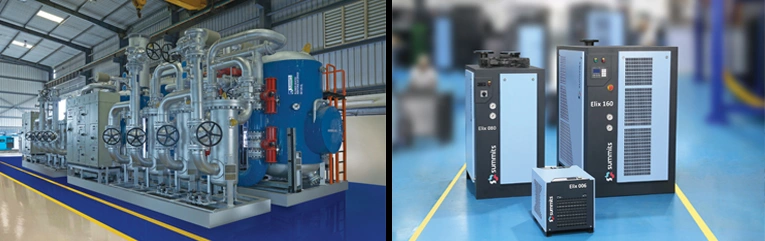
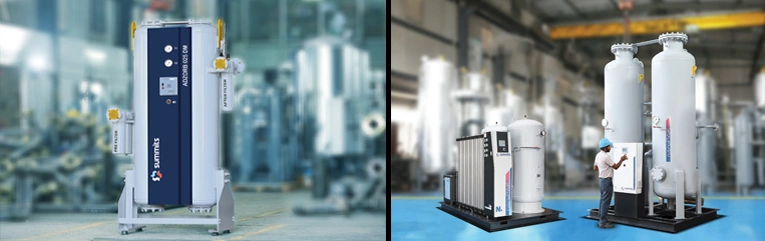
- Standard products: Elix refrigerated dryers from 10 to 15,000 cfm, Adzorb heatless dryers from 40 to 10,000 cfm, Pneuzorb compact dryers, Puro range Micro filters and Pacto zero-loss drain valves
- Custom-engineered dryers up to 25,000 cfm: heat-of-compression, vacuum pressure swing adsorption, no-loss split-flow, blower-reactivated, zero-purge and heated-purge designs, as well as hydrogen gas dryers
- Gas generation: nitroPAK nitrogen generators up to 3,000 Nm³/h, and OxyLife medical oxygen plants
For the customer, this means one engineering team sizing the complete system, one accountable supplier and one service relationship. It also means impartial advice: we recommend the right technology because we make all of them.
Q. Summits designs and builds in-house to an unusual degree. Which capabilities do you control, and how do they show up in quality and delivery?
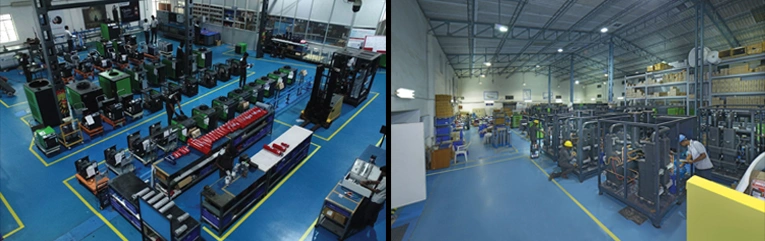
Every stage that determines performance is done in our own facility. Design is carried out on Solid Edge 3D modeling, through our partnership with Siemens. Flow distribution and stress are validated with ANSYS simulation and CFD before anything is built. Pressure vessels are fabricated in-house on an automated welding line and certified under ASME Boiler and Pressure Vessel Code U, U2 and UM stamps. Refrigeration circuits, controls, assembly and performance testing on our own test rigs all happen under the same roof.
Our management systems are certified to ISO 9001:2015 for quality, ISO 13485:2016 for medical devices and ISO 14001:2015 for environment, together with ISO 45001, and our products carry CE marking.
For the customer this means three things:
- Quality: We control every weld, vessel and circuit, and test each unit against its rating.
- Customisation: Non-standard flows, pressures, dew points or footprints are engineered, not forced into a catalogue model.
- Delivery: With no dependence on outside fabricators, we keep the lead times we commit to.
![Machines]() Q. Your custom dryers serve power, nuclear, oil and gas, defence and space. What does engineering for these applications involve, and what role do consultant approvals play?
 Q. Your custom dryers serve power, nuclear, oil and gas, defence and space. What does engineering for these applications involve, and what role do consultant approvals play?
In these sectors the dryer is part of a safety-critical process. A refinery gas dryer handles hydrocarbons, not air. A nuclear plant demands documentation and quality traceability at every step. A wind tunnel or missile test facility needs very large flows at high pressure, with dew points as low as −83 °C.
Each project starts from the consultant’s specification. We prepare process calculations, GA drawings, P&IDs and a quality assurance plan, and we build under third-party inspection.
This track record has earned approvals from Engineers India Limited, Tata Consulting Engineers, PDIL, Technip Energies and many more. We are also approved by end users including NTPC, Indian Oil, BPCL, GAIL, ONGC, BARC, ISRO, DRDO, Adani Power and several state power utilities. These approvals qualify Summits for projects where only vetted vendors may bid. For end users they are independent assurance that we deliver to specification.
Q. Can you share some installations where Summits engineering solved problems standard equipment could not?
Two examples show the range.
For the trisonic wind tunnel at ISRO’s Vikram Sarabhai Space Centre in Thiruvananthapuram, we supplied two blower-heated non-purge air dryers. Each handles 15,824 Nm³/h at 22 bar assuring an outlet moisture content of 5 ppm(w). At that pressure and flow, the vessels, valves and regeneration system all had to be engineered specifically for the application.
At Indian Oil’s Panipat refinery, we built a debutaniser overhead gas dryer package: a blower-reactivated dryer that dries methane and ethane at 1,000 Nm³/h. Drying a hydrocarbon gas stream needs hazardous-area design and materials suited to the process gas. This is a different discipline from drying compressed air.
![office summits]() Q. On-site nitrogen generation is replacing cylinders and liquid supply. Where do you see demand, and how does Summits serve such different requirements?
 Q. On-site nitrogen generation is replacing cylinders and liquid supply. Where do you see demand, and how does Summits serve such different requirements?
Cylinders and liquid nitrogen tie a plant to logistics and price swings. PSA generation produces nitrogen from compressed air at the point of use. The strongest demand we see is in pharmaceuticals, chemicals, food packaging, electronics and automotive.
These customers need very different things. A modified-atmosphere packaging line needs 15–30 litres per minute. A semiconductor equipment plant needs 99.999% purity. A fertiliser plant needs hundreds of Nm³/h. Our nitroPAK range covers this spread: MAP and OE units, modular generators up to 160 Nm³/h, twin-tower systems up to 3,000 Nm³/h, and engineered plants beyond that.
Because we also make the dryers and filters upstream, we supply the complete package. Properly treated feed air is one of the most important factors in long sieve life.
Q. Summits has also built a significant healthcare business. What does it cover?
The same expertise in adsorption and air purification applies directly to hospitals. Our OxyLife medical oxygen generators deliver up to 1,250 litres per minute. We have delivered more than 410 medical oxygen plants, including installations for various hospitals during pandemic and helped the nation to save many lives.
Our mLife medical air dryers, from 10 to 250 cfm, breathing air purifiers, and vacuum filters complete the range. Our medical products are manufactured under ISO 13485:2016, the quality standard for medical devices.
![summits machines]() Q. Energy is the largest lifetime cost of compressed air treatment. Where do plants lose the most, and how do Summits designs reduce it?
 Q. Energy is the largest lifetime cost of compressed air treatment. Where do plants lose the most, and how do Summits designs reduce it?
Most plants watch the compressor and overlook what happens downstream. Two losses dominate.
The first is purge air. A conventional heatless desiccant dryer vents a significant share of its rated flow, typically around 15%, to regenerate itself. That is air the plant paid to compress. Our engineered range is built to eliminate it. Heat-of-compression dryers regenerate using the compressor’s own waste heat. Our no-loss split-flow, zero-purge and blower-heated non-purge designs bring purge loss close to zero, even at 25,000 cfm.
The second is pressure drop. Every extra bar costs roughly 6–7% more compressor power. We size vessels, valves and filters for low differential pressure.
We offer customers a lifecycle cost comparison at the selection stage, not just a purchase price.
Q. How do you reach customers today, and what are your priorities for the next five years?
We reach the market through three routes. Across India, a nationwide network of channel partners and business associates sells and services our standard products, and leading OEMs supply Summits equipment with their systems. For engineered projects, we work directly with EPC contractors, consultants and end users. Overseas, channel partners in the UAE, Saudi Arabia, Qatar, Oman, Kuwait and Bahrain serve the Gulf. Our equipment also runs in Southeast Asia, Europe, the Americas and Africa.
Over the next five years, three trends will shape the industry: stricter air quality requirements, energy efficiency as a purchase criterion, and the move to on-site gas generation. Our priorities follow from these:
- deepen our presence in the Middle East and Far East
- bring energy-saving designs into standard products, not just engineered ones
continue investing in R&D and testing, so that Summits remains the partner industry turns to when an application is demanding.