


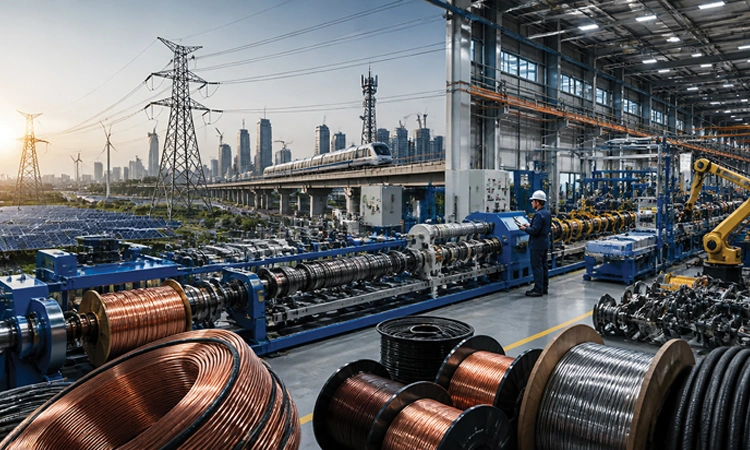
India’s cable and wire industry is undergoing a significant transformation, driven by rapid infrastructure development, electrification, renewable-energy expansion, urbanisation and the country’s growing manufacturing ambitions. From power transmission and distribution to telecommunications, railways, construction, automobiles and industrial automation, cables and wires form the essential connective tissue of India’s modern economy. With investments flowing into infrastructure and energy projects, the industry is witnessing strong demand not only for conventional power cables but also for specialised products offering higher performance, safety, efficiency and reliability. The shift towards smart infrastructure and Industry 4.0 is creating additional opportunities for manufacturers capable of delivering technologically advanced solutions.
Infrastructure Driving Demand
One of the principal growth engines for the cable and wire industry is India’s continuing infrastructure expansion. New residential and commercial buildings, industrial facilities, highways, airports, metro systems and railway networks require extensive electrical cabling.
The expansion of urban infrastructure is particularly significant. As cities grow, demand is increasing for reliable power distribution networks, building wires, fire-resistant cables, communication cables and specialised wiring systems.
The government’s emphasis on infrastructure development and manufacturing is further supporting this momentum. Large-scale investments in power generation, transmission and distribution are creating substantial opportunities for cable manufacturers.
Renewable Energy Opens New Markets
India’s rapid adoption of renewable energy is another major catalyst. Solar and wind installations require specialised cables capable of withstanding demanding environmental conditions over long operating periods.
Solar photovoltaic systems, for instance, require cables with resistance to ultraviolet radiation, temperature variations and moisture. Wind farms similarly require flexible and durable cables for electrical connections and control systems.
The development of renewable-energy parks and increasingly distributed generation is therefore creating demand across the entire cable ecosystem—from power evacuation and transmission to specialised cables used within individual installations.
Battery energy storage systems and electric-vehicle infrastructure represent additional emerging markets. As India develops a broader energy-storage ecosystem, manufacturers will increasingly need to supply cables designed for high-current, high-temperature and demanding electrical environments.
Power Transmission and Distribution
Electricity transmission and distribution remain among the industry’s largest application areas. India’s expanding electricity demand requires stronger and more efficient transmission infrastructure, particularly as generation increasingly comes from geographically dispersed renewable-energy projects.
High-voltage and extra-high-voltage cables are becoming increasingly important in applications where reliability, compact installation and reduced transmission losses are critical.
Underground cabling is also gaining attention in urban areas where overhead transmission and distribution networks face space constraints, aesthetic considerations and reliability challenges.
The move towards modern distribution networks is creating opportunities for technologically advanced cable systems offering improved insulation, monitoring and fault-detection capabilities.
Growth of Manufacturing and Industrial Automation
India’s emergence as a global manufacturing hub is generating another important source of demand. New factories, industrial parks and production facilities require extensive electrical and control cabling.
The growth of automation is particularly relevant. Robots, CNC machines, automated material-handling systems and production lines require specialised cables designed for continuous flexing, torsion and high-speed movement.
Industrial Ethernet, sensor cables, control cables and other communication products are increasingly becoming essential components of connected manufacturing systems. As factories embrace Industry 4.0, the cable is no longer merely a passive electrical component—it is part of the information infrastructure of the factory.
Automotive and Electric Vehicles
The automotive industry represents a rapidly evolving market for cable and wire manufacturers. Conventional vehicles require extensive wiring harnesses, while electric vehicles introduce entirely new requirements.
EVs use high-voltage cables for connecting batteries, inverters, motors and charging systems. These cables need to combine electrical performance with thermal resistance, mechanical durability and safety.
The growth of charging infrastructure is creating further demand. Public and private charging stations require power cables capable of handling high electrical loads reliably and safely.
As vehicle architectures become increasingly electronic, lightweight and compact wiring solutions will become even more important.
Telecommunications and Data Connectivity
The expansion of digital infrastructure is creating opportunities beyond traditional electrical applications. Broadband networks, data centres, telecommunications infrastructure and 5G deployment require a wide range of cables and connectivity products.
India’s rapidly expanding digital economy is increasing the importance of high-speed data transmission. Fibre-optic cables are playing a particularly important role in connecting homes, businesses, data centres and communication networks.
The growth of cloud computing and artificial intelligence is also driving investments in data centres, where power and data connectivity are critical. This is creating demand for reliable electrical and communication cabling systems capable of supporting high-density installations.
Technology and Product Innovation
Competition in the cable industry is increasingly shifting from capacity alone to technology, quality and value-added solutions.
Manufacturers are investing in advanced extrusion systems, automated production lines, online inspection technologies and sophisticated testing equipment. Precision in conductor manufacturing, insulation thickness and material composition is essential for achieving consistent performance.
Fire safety is another important area of innovation. Low-smoke, halogen-free and fire-resistant cables are increasingly being adopted in buildings and critical infrastructure where minimising smoke and toxic emissions during a fire is essential.
Manufacturers are also developing cables with improved temperature ratings, flexibility, chemical resistance and mechanical strength for specialised industrial applications.
Sustainability Becomes a Priority
Environmental considerations are becoming increasingly important throughout the cable and wire value chain. Manufacturers are looking at ways to reduce energy consumption, material wastage and emissions during production.
Copper and aluminium, the industry’s principal conductor materials, have significant recycling potential. Efficient recovery and recycling can reduce the environmental footprint associated with raw-material production.
There is also growing interest in materials and manufacturing processes that improve cable life and reduce replacement frequency. A longer-lasting cable can provide both economic and environmental benefits.
Challenges Ahead
Despite its strong growth prospects, the industry faces several challenges. Copper and aluminium prices can be volatile, directly affecting manufacturing costs and product pricing. Manufacturers must also manage fluctuations in demand and maintain efficient working-capital cycles.
Quality and safety remain critical concerns. The presence of substandard products in the market can affect customer confidence and create serious safety risks. Strong testing, certification and adherence to applicable standards are therefore essential.
The industry must also continuously invest in technology and skills to keep pace with rapidly changing requirements in renewable energy, EVs, automation and digital infrastructure.
The Road Ahead
The outlook for India’s cable and wire industry remains highly promising. Electrification, infrastructure development, renewable energy, EV adoption, industrial automation, digitalisation and data-centre expansion are likely to sustain demand across multiple segments.
At the same time, India’s ambition to become a major manufacturing and export hub creates opportunities for domestic cable manufacturers to strengthen their global presence. Companies that combine scale with quality, innovation, reliability and sustainability will be best positioned to benefit.
The cable and wire industry is therefore evolving from a conventional electrical-component sector into a technologically sophisticated industry supporting India’s energy, mobility, manufacturing and digital transformation.
Every power line, factory, vehicle, renewable-energy project and digital network depends on reliable connectivity. As India builds the infrastructure of its future, the cable and wire industry will remain one of the critical industries powering that journey.