

Advanced Skill Training in Servo Motion Control –
Building the Workforce for Smart Manufacturing and Industry 4.0

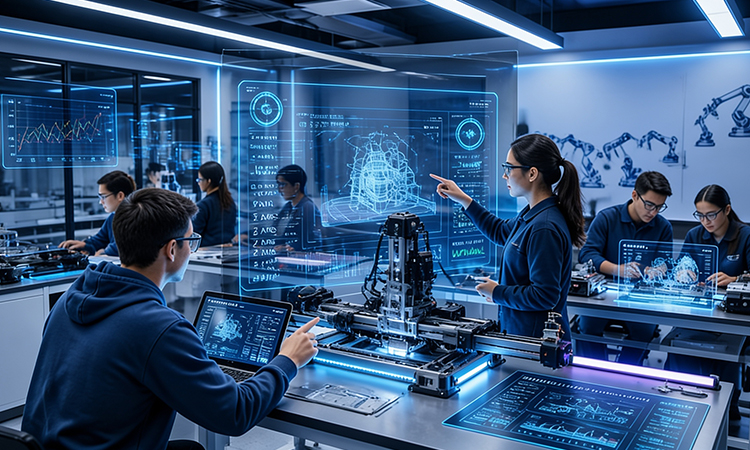
The manufacturing sector is undergoing a fundamental transformation. Automation, robotics, digitalization, and smart factories are rapidly replacing conventional production methods, creating a demand for a new generation of engineers equipped with advanced technical skills. Among the many technologies driving this change, servo motion control has emerged as one of the most critical. Whether it is a CNC machining center producing aerospace components, a robot assembling automotive parts, a packaging machine operating at high speed, or a semiconductor manufacturing system requiring micron-level precision, servo motion control forms the backbone of modern industrial automation.
As industries increasingly adopt intelligent manufacturing systems, educational institutions are recognizing the need to equip students with practical expertise in motion control technologies. Engineering colleges such as Bannari Amman Institute of Technology (BIT), Sathyamangalam, have taken proactive steps to include advanced skill training in servo motion control as part of their curriculum, helping bridge the gap between classroom learning and industrial expectations.
Understanding Servo Motion Control
A servo motion control system is designed to precisely control the movement of machines and equipment. Unlike conventional motors that operate at fixed speeds or positions, servo systems continuously monitor and adjust their performance using feedback devices such as encoders and sensors.
The key elements of a servo system include:
• Servo motors
• Servo drives
• Motion controllers
• Feedback devices
• Industrial communication networks
• Human-machine interfaces
Together, these components ensure precise control of position, speed, acceleration, and torque.
The technology finds application in virtually every advanced manufacturing sector, including:
• Machine tools
• Robotics
• Packaging machinery
• Printing equipment
• Electronics manufacturing
• Pharmaceutical production
• Material handling systems
• Aerospace engineering
As production tolerances become tighter and manufacturing speeds increase, the importance of servo motion control continues to grow.
Why Industry Demands These Skills
The emergence of Industry 4.0 has fundamentally altered workforce requirements. Modern manufacturing facilities no longer seek engineers who possess only theoretical knowledge. Instead, they require professionals who can configure, program, commission, troubleshoot, and optimize sophisticated automation systems.
Servo motion control has become a core competency because it directly impacts:
• Machine accuracy
• Productivity
• Product quality
• Energy efficiency
• Equipment reliability
A poorly tuned servo system can result in vibration, positioning errors, excessive wear, and reduced productivity. Conversely, a well-optimized system can dramatically improve machine performance and operational efficiency. This makes servo motion control expertise highly valuable across a wide range of industries.
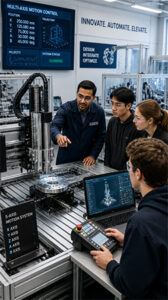
The Shift Toward Hands-On Learning
Traditional engineering education has long focused on theoretical concepts such as electrical machines, control systems, and electronics. While these subjects remain important, industry increasingly demands practical exposure to real-world applications. Advanced training programs in servo motion control address this need by allowing students to work directly with industrial hardware and software.
Training modules typically include:
• Servo motor operation
• Drive configuration
• Motion programming
• Position control
• Velocity control
• Torque control
• Multi-axis synchronization
• Motion profiling
• Industrial networking
Students gain hands-on experience in setting up and tuning servo systems while learning how motion control is integrated into automated machinery. This practical exposure significantly enhances their readiness for industrial careers.
Preparing Engineers for Smart Factories
The factory of the future is characterized by interconnected machines, intelligent automation, real-time data exchange, and autonomous decision-making. Servo motion control serves as a foundational technology within this environment. Advanced manufacturing systems rely on synchronized motion between multiple machine axes to achieve precise and repeatable operations.
Examples include:
• CNC machining centers
• Robotic welding cells
• Automated assembly systems
• Pick-and-place machines
• Packaging lines
• Semiconductor manufacturing equipment
Engineers responsible for these systems must understand not only mechanical design and electrical engineering but also motion algorithms, machine communication protocols, and automation software. Skill-based training helps students acquire these interdisciplinary capabilities before entering the workforce.
Industry-Academia Collaboration
One of the most encouraging developments in engineering education is the increasing collaboration between industry and academia. Leading educational institutions are establishing specialized laboratories and Centres of Excellence equipped with industrial-grade automation systems. These facilities provide students with exposure to technologies currently used in manufacturing environments.
Institutions such as Bannari Amman Institute of Technology have recognized the growing importance of servo motion control and have incorporated specialized training modules that focus on industrial automation, motion control systems, robotics, and smart manufacturing technologies. Such initiatives enable students to work on real-world projects involving motion control applications, trajectory planning, servo tuning, and machine automation. The result is a workforce better aligned with the needs of modern industry.
Career Opportunities in Motion Control
Engineers trained in servo motion control enjoy access to a wide range of career opportunities.
Potential roles include:
• Automation Engineer
• Motion Control Engineer
• CNC Application Engineer
• Robotics Engineer
• Mechatronics Engineer
• Industrial Controls Engineer
• Commissioning Engineer
• Machine Design Engineer
These professionals are employed across sectors such as automotive manufacturing, machine tool production, aerospace, electronics, pharmaceuticals, logistics, and renewable energy. As automation continues to expand globally, demand for motion control specialists is expected to remain strong for years to come.
Emerging Trends in Servo Motion Technology
The field of servo motion control continues to evolve rapidly. Several emerging technologies are shaping its future:
Artificial Intelligence
AI-driven motion systems can automatically optimize machine performance and adapt to changing operating conditions.
Digital Twins
Virtual replicas of machines allow engineers to simulate motion profiles and optimize system performance before physical deployment.
Collaborative Robotics
Servo-controlled collaborative robots are becoming increasingly common in manufacturing environments where humans and machines work together.
Industrial IoT
Connected servo systems provide real-time operational data that supports predictive maintenance and performance monitoring. These innovations are expanding the capabilities of motion control systems while creating new opportunities for skilled engineers.
The Road Ahead
As manufacturing transitions toward greater automation and digitalization, servo motion control will remain one of the most important enabling technologies. The success of future factories will depend heavily on engineers capable of designing, implementing, and maintaining sophisticated motion systems. Educational institutions that incorporate advanced skill training in servo motion control are therefore making a valuable contribution to industrial development. By combining theoretical knowledge with practical application, they are producing graduates who are prepared to meet the challenges of modern manufacturing.
Conclusion
Servo motion control has become a cornerstone of contemporary industrial automation, powering everything from CNC machine tools and robotic systems to advanced production lines and smart factories. As industries demand higher levels of precision, productivity, and flexibility, the need for engineers skilled in motion control technologies continues to grow.
Advanced skill training programs offered by progressive institutions provide students with the practical expertise required to thrive in this evolving landscape. By fostering hands-on learning, industry collaboration, and exposure to real-world automation systems, such programs are helping create the highly skilled workforce needed for the factories of the future. In an era defined by Industry 4.0, servo motion control is not merely a technical specialization-it is a critical competency that will shape the next generation of manufacturing excellence.