


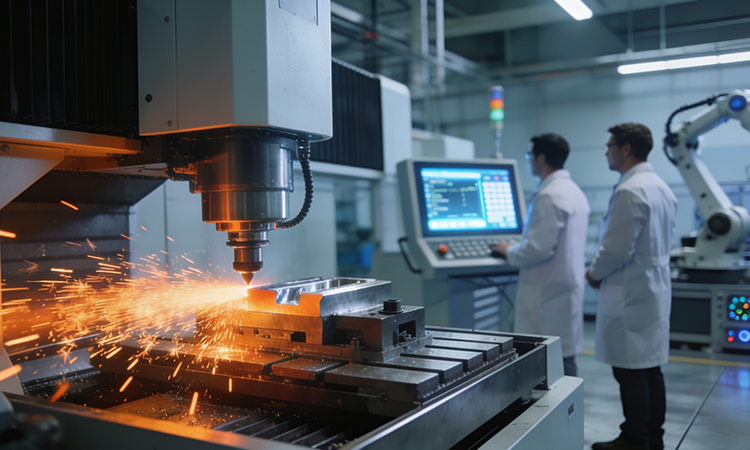
Modern manufacturing continually pushes the boundaries of precision, complexity, and material performance. Industries such as aerospace, automotive, medical devices, electronics, defense, and toolmaking increasingly rely on components made from hardened steels, titanium alloys, tungsten carbide, and other difficult-to-machine materials. Producing intricate shapes and ultra-precise features in these materials often exceeds the capabilities of conventional machining processes. This is where Spark Erosion Machines, more commonly known as Electrical Discharge Machines (EDM), come into play.
Spark erosion technology is one of the most remarkable advancements in precision manufacturing. Unlike traditional machining methods that remove material through physical cutting, EDM uses controlled electrical discharges to erode material with exceptional accuracy. Over the years, spark erosion machines have evolved into highly sophisticated CNC-controlled systems capable of producing components that would otherwise be impossible to manufacture.
Today, EDM technology has become an indispensable part of modern manufacturing, particularly in tool rooms, mold and die shops, aerospace facilities, and precision engineering industries.
Understanding the Spark Erosion Process
The principle behind spark erosion is surprisingly simple yet highly effective. Whenever two electrically conductive materials are separated by a small gap and subjected to a high electrical potential, a spark is generated. In EDM, this spark is controlled and utilized as a machining tool.
The process involves:
• A conductive workpiece
• An electrode
• A dielectric fluid
• A pulse power supply
• A CNC-controlled servo system As the electrode approaches the workpiece, a tiny gap is maintained between the two surfaces. Electrical pulses generate a series of sparks that jump across this gap. Each spark creates an intense localized temperature, often exceeding 10,000°C. The extreme heat instantly melts and vaporizes microscopic particles of material from the workpiece surface. The dielectric fluid then flushes away these particles, preparing the area for the next discharge. Thousands of sparks occur every second, gradually removing material and creating the desired shape with extraordinary precision. Because there is no physical contact between the tool and the workpiece, even the hardest conductive materials can be machined without generating cutting forces.
Why EDM is Different from Conventional Machining
Traditional machining processes rely on cutting tools that physically remove material through mechanical action.
However, EDM offers several unique advantages:
• No cutting forces
• Ability to machine hardened materials
• Production of complex geometries
• High dimensional accuracy
• Superior surface finish
• Minimal distortion
• Reduced tool wear on hard materials This capability makes EDM particularly valuable when machining components that have already undergone heat treatment or require intricate internal features. For many applications, spark erosion is not merely an alternative machining process-it is the only viable solution.
Types of Spark Erosion Machines
Modern EDM technology encompasses several machine categories designed for specific applications.
Die-Sinking EDM
Die-sinking EDM, also known as Ram EDM, utilizes a specially shaped electrode that reproduces its geometry onto the workpiece.
The electrode is typically manufactured from:
• Graphite
• Copper
• Copper-tungsten alloys
As the electrode advances into the workpiece, it creates cavities that precisely match its shape.
Die-sinking EDM is widely used for:
• Injection mold manufacturing
• Die casting dies
• Forging dies
• Extrusion dies
• Aerospace components
The process is particularly effective for creating complex three-dimensional cavities and sharp internal corners.
Wire EDM
Wire EDM uses a continuously moving wire electrode, typically made of brass or coated wire, to cut through conductive materials. The wire never physically contacts the workpiece, eliminating mechanical stresses during machining.
Wire EDM is extensively employed for:
• Precision tooling
• Punches and dies
• Aerospace components
• Medical instruments
• Electronic components
The process can achieve exceptionally tight tolerances while producing highly complex profiles. Many modern wire EDM systems routinely achieve accuracies within a few microns. Fast Hole EDM
Fast hole drilling EDM is designed specifically for producing small, deep holes in conductive materials.
Applications include:
• Turbine blade cooling holes
• Fuel injector components
• Aerospace parts
• Medical instruments
The process enables the creation of high-aspect-ratio holes that are difficult or impossible to produce using conventional drilling techniques.
Industries Driving EDM Demand
Spark erosion machines play a crucial role across numerous industries.
Tool and Die Manufacturing
Perhaps no sector relies more heavily on EDM than the tool and die industry.
Manufacturers use EDM for:
• Injection molds
• Stamping dies
• Forging dies
• Press tools
• Extrusion dies
The ability to create intricate cavities and hardened tooling components makes EDM indispensable in modern toolmaking.
Aerospace Industry
Aerospace manufacturers routinely machine high-strength superalloys and heat-resistant materials.
EDM enables the production of:
• Turbine components
• Engine parts
• Fuel system components
• Structural elements
Its ability to maintain dimensional accuracy while machining difficult materials is particularly valuable in aerospace applications.
Medical Device Manufacturing
Medical implants and surgical instruments often require complex geometries and exceptional surface quality.
EDM is used to manufacture:
• Orthopedic implants
• Surgical tools
• Dental components
• Precision medical instruments
The process supports the high standards of precision and quality demanded by the healthcare sector.
Electronics Industry
As electronic devices become smaller and more sophisticated, EDM is increasingly used to produce miniature precision components.
Applications include:
• Connectors
• Semiconductor tooling
• Micro-components
• Electronic housings
The ability to machine delicate and intricate features makes EDM an important technology for electronics manufacturing.
Advances in EDM Technology
EDM technology has evolved significantly over the past decade.
CNC Automation
Modern EDM machines feature advanced CNC controls that enable:
• Multi-axis machining
• Automatic electrode changing
• Adaptive process control
• Real-time monitoring
These capabilities improve productivity while reducing operator intervention.
Intelligent Spark Control
Advanced power generators continuously optimize discharge conditions during machining.
Benefits include:
• Faster machining speeds
• Improved surface finish
• Reduced electrode wear
• Greater dimensional accuracy
Sophisticated control systems can automatically adjust machining parameters based on process conditions.
Automation and Robotics
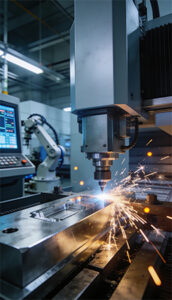
Many EDM installations now operate as fully automated manufacturing cells.
Robotic systems perform:
• Workpiece loading
• Electrode handling
• Tool changing
• Inspection integration
Automation enables lights-out manufacturing, maximizing machine utilization and productivity.
Industry 4.0 Integration
Modern spark erosion machines increasingly support Industry 4.0 initiatives through:
• Remote monitoring
• Predictive maintenance
• Cloud connectivity
• Production analytics
Manufacturers can track machine performance, optimize processes, and reduce downtime through real-time data analysis.
Challenges in EDM
Despite its advantages, EDM is not without challenges.
These include:
• Relatively slower material removal rates
• Requirement for electrically conductive materials
• Electrode wear in die-sinking operations
• Dielectric fluid management
• Higher equipment costs
However, when precision, complexity, and material hardness become critical factors, EDM often remains the preferred solution. Manufacturers continue to address these challenges through innovations in power supplies, electrode materials, and process optimization.
The Future of Spark Erosion Technology
The future of EDM is closely linked to advances in digital manufacturing and smart machining.
Emerging trends include:
• Artificial intelligence-based process optimization
• Hybrid machining systems
• Micro-EDM technologies
• Enhanced automation
• Digital twin integration
• Sustainable dielectric systems
Researchers are also exploring environmentally friendly dielectric fluids and energy-efficient EDM systems that reduce environmental impact while maintaining performance. As industries continue to demand higher precision and increasingly complex components, EDM technology will remain a vital manufacturing process.
Conclusion
Spark erosion machines have fundamentally transformed precision manufacturing by enabling the machining of complex geometries and hardened materials that are difficult or impossible to process using conventional methods. Through the controlled application of electrical discharges, EDM delivers exceptional accuracy, surface quality, and versatility across a wide range of industrial applications.
From mold and die manufacturing to aerospace engineering, medical device production, and electronics fabrication, EDM continues to play a critical role in meeting the demands of modern industry. Advances in CNC controls, automation, intelligent process management, and Industry 4.0 connectivity are further enhancing its capabilities and expanding its applications. While often operating behind the scenes, spark erosion machines remain among the most important technologies in advanced manufacturing. Their unique ability to machine the seemingly unmachinable ensures that EDM will continue to be a cornerstone of precision engineering for years to come.